Showing posts with label Vitamin C. Show all posts

Saturday, January 12, 2013

What is the relationship between polyphenols antioxidants, flavanols and lignans?

Strawberries Strawberry
It it commonly said that antioxidants have anti-cancer properties, as well as every other health benefit imaginable, from preventing pathogens to reducing seasonal allergies.
"Phenolic compounds have diverse defensive functions in plants, such as cell wall strengthening and repair (lignin and suberin) and antimicrobial and antifungal activities. Some polyphenols are phytoanticipins, compounds with a defensive role that are not synthesised in response to a pathogen attack but rather are constitutively present in plant cells.

"Phenolic constituents occur on the surface of plants or in the cytoplasmic fraction of the epidermal cells, where they act as a deterrent to pathogens. In contrast, phenolic phytoalexins are secreted by wounded plants or in response to incompatible pathogens. The induced defense response includes cell death and the formation of a lesion that limits the growth of the pathogen. Cells around the lesion accumulate polyphenols and other antibiotic compounds."

Plant Polyphenols and Their Anti-Cariogenic Properties: A Review by Gianmaria F. Ferrazzano, Ivana Amato, Aniello Ingenito, Armando Zarrelli, Gabriele Pinto and Antonino Pollio
The average article will talk about one antioxidant such as resveratrol (found in red wine and grapes) or rutin (found in buckwheat and asparagus). The article will mention a handful of foods, a handful of benefits, and it'll throw out a handful of other terms such as "flavonoid" or "polyphenol" or "phytochemical."
This is all well and good, but it doesn't explain the relationship between all of these substances.
Hence, this page will serve as a somewhat comprehensive reference for polyphenols (which are antioxidants).
This article is still somewhat of a work in progress. (January 12th-16th 2013)
Raederle's Art for Raederle.com
Phtyochemicals include antioxidants.
Antioxidants include polyphenols.
Polyphenols include flavonoids.
Flavonoids include flavanones.
Flavanones include hesperetin, naringenin, and eriodictyol.
Food sources: citrus fruits such as oranges, grapefruits and lemons.
Flavonoids include anthocyanidins.
Anthocyanidins include pelargonidin, cyanidin, delphinidin, petunidin, and malvidin.
Food sources: black grapes, and red wine.
Flavonoids include isoflavones.
Isoflavones include genistein, and daidzein.
Food sources: organic soy (not overly processed soy products).
Flavonoids include flavones.
Polyphenols also include phenolic alcohols.
Phenolic alcohols include coniferyl alcohol, sinapyl alcohol, and para-coumaryl.
Food sources: possibly pine-needle tea.
Polyphenols also include phenolic acids.
Phenolic acids include benzoic acid, and cinnamic acid.
Benzoic acid includes gallic acid.
Food sources: Pomegranates, rooibos tea, flax seeds, watercress, grape seed, gallnuts, sumac (culinary spice with tart flavor), and tea leaves.
Cinnamic acid includes caffeic acid, and ferulic acid.
Phenolic acids include tannic acid.
Food sources: grapes, green tea, and persimmons.
Phenolic acids include vanillin.
Food sources: vanilla bean.
Food sources: coffee, blueberries, kiwis, plums, cherries, red wine, apples, brown rice, oat groats, artichokes, oranges and pineapples.
Flavonoids include flavones.
Flavones include apigenin, luteolin and tangeritin.
Apigenin food sources: parsley, celery, rosemary, oregano, thyme, basil, coriander, chamomile, cloves, lemon blam, artichokes, spinach, peppermint, red wine and licorice.
Luteolin food sources: celery leaves and seeds, green pepper, thyme, perilla, chamomile tea, carrots, olive oil, peppermint, rosemary, lentils, black olives, navel oranges, clover blossom, lettuce, globe artichoke, dandelion, and oregano.
Tangeritin food sources: tangerine peels, and citrus peels.
Flavonoids include flavonols (not to be confused with flavanols).
Flavonols include isorhamnetin, kaempferol, myricetin, proanthocyanidins (condensed tannins), quercetin, and rutin.
Isorhamnetin food sources: almonds, chives, dill weed, fennel leaves, red onion and turnip greens.
Kaempferol food sources: broccoli, tea, grapefruit, curly raw endive leaves, cabbage, kale, beans, endive, leek, tomato, strawberries, grapes, Brussels sprouts, and apples.
Myricetin food sources: walnuts, red wine and grapes, onions, tea, and berries.
Proanthocyanidins food sources: chokeberries, rose hips, cacao beans, berries, persimmons, grapes and red wine, peaches, apples and apple cider, pears, and green tea.
Quercetin food sources: black chokeberry, cranberry, lettuce, quince fruit, apples, citrus fruits, onions, parsley, red wine and grapes, tea, bilberries, blackberries, blueberries, dark cherries, and buckwheat.
Rutin food sources: buckwheat, asparagus, citrus fruits and their rinds, cherries, apricots, green peppers, rooibos tea, blueberries, blackberries, and mulberries.
Flavonoids include flavanones.
Flavanones include eriodictyol, hesperetin, and naringenin.
Food sources: peppermint, kumquats, lemons, pumellos, limes, grapefruits, oranges, tangerines, tangelo, artichokes, red wine and white wine, basil, dill weed, thyme, rosemary, lemon balm, terragon, chives, coriander, garden cress, parsley, and watercress.
Flavonoids include flavanols (and their polymers).
Flavanols (and their polymers) include catechin and gallocatechin (gallocatechin includes catechin just as the name implies), epicatechin, and epigallocatechin, theaflavin, thearubigins, and procyanidin.
Catechin/epicatechin food sources: Green tea, cacao beans, oolong tea, kiwi, apples, apricots, nectarines, pears, plums, blackberries, red raspberries, cranberries, cherries, raisins and grapes and red wine, rhubarb, and barley.
Gallocatechol/gallocatechin food sources: green tea, bananas, persimmson, almonds, plums, cacao beans, kiwi, apples, and pomegranate.
Theaflavin and Thearubigins food sources: fermented teas—The tea will be "black" but not all black teas are fermeneted. These two antioxidants are only found in fermented tea, not in green tea before fermentation.
Procyanidin food sources: apricot, nectarine, kiwi, pomegranate, peach, blackberry, strawberry, green beans, persimmons, cranberries, apples, cacao beans, and red wine.
Flavonoids include isoflavones.
Isoflavones include daidzen, genistein, and glycitein.
Food sources: organic unproccessed soy beans, fava beans, psoralea corylifolia (Indian bread root), kudzu root and kwao krua root.
Flavonoids include anthocyanidins.
Anthocyanidin include cyanidin (anthocyanins are glycosides of anthocyanidins)
Food sources: grapes, bilberry, blackberry, blueberry, cherry, cranberry, elderberry, hawthorn, loganberry, acai berry, raspberry, apples, plums, red cabbage and red onion.
Flavonoids include anthocyanins.
Anythocyanins include delphinidin.
Food sources: grapes, cranberries, and pomegranates.
Flavonoids include anthocyanins.
Anythocyanins include malvidin.
Food sources: red wine and grapes, chokeberries, and saskatoon berries.
Flavonoids include anthocyanins.
Anythocyanins include pelargonidin.
Food sources: raspberries, strawberries, blueberries, blackberries, plums, cranberries, pomegranates and red kidney beans.
Flavonoids include anthocyanidins.
Anthocyanidins include peonidin.
Food sources: raw cranberries, blueberries, plums, grapes, and cherries.
Flavonoids include anthocyanidins.
Anthocyanidin include petunidin.
Food sources: chokeberries, saskatoon berries, and muscadine grapes.
Phtyochemicals include antioxidants.
Antioxidants include polyphenols.
Polyphenols include a classification called Other Polyphenols.
Other polyphenols include hydroxyphenylpropenes.
Hydroxyphenylpropenes includes eugenol.
Food sources: Cloves, ceylon cinnamon, nutmeg, lemon balm, dill, and Japanese star anise.
Antioxidants include polyphenols.
Polyphenols include lignans.
Lignans include lariciresinol, pinoresinol, secoisolariciresinol, matairesinol, sesamin, and arctigenin (to name a few).
Food sources: flax seeds, kale, broccoli, apricots, strawberries, seseme seeds and cabbage.
Antioxidants polyphenols free radicals oxidation chart reference
Raederle's Art for Raederle.com

Sources Of Raederle's Polyphenol Research

"Natural Polyphenols" by Duke Liberatore and Jan Mcbarron, M.D.
Note: This is where I found reference to bilberries being a source of anthocyanins.
Flavonoid Chart by Dr. Delgado
Note: This is where I found many of the food sources of various flavanoids.
"Phytonutrients: Stilbenes"
Note: This is where I got the food sources for stilbenes.
Stilbene
Note: This is where I found "Itadori tea" as a stilbene source.
Phenolic Alcohols
Note: This is where I found information on the three kinds of phenolic alcohols.
Benzoic Acid
Note: This is where I found the food sources for benzoic acid.
Phenolic Acids
Note: This is where I found the two primary types of phenolic acid.
Wikepedia Antioxidant List
Note: I found this in particular to find cinnamic acid food sources, but from there continued to use it as a reference for many other things included on this page.
Colors in Food
Note: I found this page when looking for the color of flavonols.
Proanthocyanidins in Common Food Products of Plant Origin
Note: I learned from reading this that there are definitely properties (benefits) of fruits that are not found in vegetables, which I personally find fascinating. I think it would be safe to assume that a reverse is true, especially when considering chlorophyll.
Phytochemicals in Foods—13 Health Benefits of Gallocatechin
Note: This is where I found plums, apples and almonds as a source of gallocatechin.
A comparative survey of leguminous plants
Note: This is where I found psoralea corylifolia as a high source for genisteim.
Daidzein, a phytoestrogen
Note: This is where I found kudzu root as a source for daidzein.
Phenolic Compounds
Note: This is where I found tannic acid as a phenolic acid.
Phenol Explorer
Note: I wish I had found this earlier on in my research on this topic. This is an excellent resource for figuring out how different antioxidants relate to one another.
What is Chicoric acid?
Note: This is where I found Echinacea as a source for chicoric acid.

Thursday, September 6, 2012

Celery!

The Celery Song

Celery

Celery contains vitamin C and several other active compounds that promote health, including phthalides, which may help lower cholesterol, and coumarins, that may be useful in cancer prevention.
Celery And Leeks by Raederle
Celery is not just extremely low in calories: you actually burn more calories chewing celery than you are consuming by eating celery!

Celery's Health Benefits

Weight Loss

Celery juice and whole celery help burn fat. The chewing action releases hormones in the brain the reduce cravings. Research has shown that snacking on celery reduces the urge to eat unhealthy snack items.
Celery has a balance of minerals that is very hydrating. When thirsty, we often over-eat. Because celery quenches thirst on a level beyond just drinking water, it prevents over-eating causes by thirst.

Stress Reduction

Chewing reduces stress. This is why many people choose potato chips when they are stressed out. Choose celery instead. (Other great options include kale chips, chard stems, carrots, oranges and squash chips.)

Detox

Celery appears frequently in detox diet plans. This makes sense because celery has properties that aid digestion. Because celery is mildly sweet and contains sodium, it curbs cravings.
All raw fruits and vegetables have detoxing properties. Celery in particular is excellent because it provides a mild detox and highly balanced nutrition.

Insomnia

Celery is beneficial in cases of insomnia. Celery juice particularly is very calming to the nervous system. The high magnesium levels are soothing, and helpful to relaxation, and fully restful sleep.

Constipation

Raw celery aids constipation. The high fiber content "sweeps" the colon clean. Other helpful aids in the face of constipation include: psyllium husk, aloe juice, ginger, and turmeric.

Calicum

According to Hippocrates, the father of medicine, celery calms nerves. This may be contributed to by its high calcium content.
Celery is good for the kidneys and will eliminate the body's waste through the urine. The seeds, leaves, and edible root of the plant can all be used. Celery seed in particular is very high in calcium, and it is one of the few seeds commonly available that has a positive calcium to phosphorus ratio. A single tablespoon of celery seed provides 11% of the recommended daily need for calcium.

100 Calories of Celery

Ten large ribs of celery amounts to 102 calories. The calorie breakdown is 73.4% from carbs, 9.5% from lipids and 17.1% from protein. This is a highly ideal ratio if you're trying to lose weight or build muscle.
To maintain healthy muscle you only need 10% of your total calories to come from protein (on a 2000 calorie diet), and celery contains protein in a more digestable form than foods such as meat and beans. I explain this in detail in my article about protein, amino acids and enzymes.
Ten ribs of celery (102 calories) provides roughly 20% of all of your nutrient needs for an entire day, including the following RDA values:
12% B1 (thiamine), 33% B2 (riboflavin), 15% B3 (niacin), 31% B5 (pantothenic acid), 36% B6 (pyridoxine), 58% B9 (folate), 20% vitamin A, 26% vitamin C, 12% vitamin E, 208% vitamin K, 26% calicum, 7% iron, 23% magnesium, 35% potassium, 5% selenium, 34% sodium and 10% zinc.
All of that in just 100 calories!

Potassium

Celery has a lot of potassium. Potassium is an electrolyte that is good for maintaining a healthy nervous system. It is vital for proper brain function and normal muscle growth. It lowers blood pressure and helps balance normal water levels in your body. Lack of potassium can cause heart problems, fatigue, and dry skin. Coconut water from young Thai coconuts is extremely high in potassium content as well.

Vitamin K

Celery is rich in vitamin K, which will help to suppress the appetite. Vitamin K also helps to form normal blood clots, i.e. it's the vitamin that stops you from bleeding to death.
Adults over age 50 should increase the vitamin K intake, as it aids in making essential bone proteins, preventing bone fractures and osteoporosis. A lack of vitamin K can cause liver problems, excessive bruising and bleeding.

Coumarins

Celery contains phytochemical compounds known as coumarins. Studies have shown that coumarins are effective in cancer prevention and capable of enhancing the activity of certain white blood cells. Coumarin compounds also lower blood pressure, tone the vascular system, and are possibly effective when used in cases of migraines.

After-Workout Drink

Due to the high levels of potassium and sodium, when celery-based juices are consumed after a workout they serve as great electrolyte replacement drinks. Studies have also shown that celery may help to lower cholesterol and prevent cancer by improving detoxification. Celery extract that contains 85% 3nB, has been shown to be effective in the treatment of "rheumatism". That is, celery is effective against arthritic and muscular pains.

Vitamins

Celery provides an excellent source of vitamin C and fiber. It is a very good source of folic acid, potassium, and vitamins B1 and B6. Celery also offers a good source of vitamin B2 and calcium. Even though celery contains more sodium than most other vegetables, the sodium is offset by it's high levels of potassium. Studies have shown that the sodium content of celery does not bother even the most salt-sensitive individuals. And yet, if you ate enough celery, you could meet all of your sodium needs on celery alone.

Vitamin C

Celery is an excellent source of vitamin C, a vitamin that helps to support the immune system. Vitamin C-rich foods like celery may help reduce cold symptoms or severity of cold symptoms; over 20 scientific studies have concluded that vitamin C is a cold-fighter.
Vitamin C also prevents the free radical damage that triggers the inflammatory cascade, and is therefore also associated with reduced severity of inflammatory conditions, such as asthma, osteoarthritis, and rheumatoid arthritis.
As free radicals can oxidize cholesterol and lead to plaques that may rupture causing heart attacks or stroke, vitamin C is beneficial to promoting cardiovascular health. Owing to the multitude of vitamin C's health benefits, it is not surprising that research has shown that consumption of vegetables and fruits high in this nutrient is associated with a reduced risk of death from all causes including heart disease, stroke and cancer. For more about vitamin C, read this article containing ten different ways to get a full day's supply of vitamin C from whole foods.

Blood Pressure

Celery's potential for reducing high blood pressure has long been recognized by Chinese medicine practitioners, and Western science researchers may have recently identified one reason why: Phthalides.

Phthalides

Celery contains active compounds called phthalides, which can help relax the muscles around arteries and allow those vessels to dilate. With more space inside the arteries, the blood can flow at a lower pressure.
Phthalides also reduce stress hormones, one of whose effects is to cause blood vessels to constrict. Research has shown that celery can rapidly reduce blood pressure upon consumption.

Cholesterol

In studies of animals specially bred to have high cholesterol, celery's cholesterol-lowering activity has been demonstrated. In eight weeks, aqueous solutions of celery (like celery juice) fed to specially bred high cholesterol animals significantly lowered their total cholesterol by increasing bile acid secretion.

Uses

Grated raw celery can be used on swollen glands.
Celery is used in aromatherapy and other traditional ways of healing, like Ayurveda.
In Japan, rheumatic patients are sometimes put on a celery-only-diet.
As stated before, celery is also a useful component of a detox diet.

Buying & Storing Celery

Season

Available year-round in the U.S.

Buying

Look for firm, tight bunches with healthy leaves. Avoid bruised celery as it will taste bitter. When celery (or most any plant) is damaged, it releases bittering agents to fend off bugs.

Storing

Refrigerate in a plastic bag (preferably a green bag) and place in the crisper for up to two weeks. If the ribs are wilted, separate the ribs and place them in a bowl of ice water for several minutes before use.
You can also store upright in a vase with a little water or a wet towel at the bottom of the vase inside or outside the fridge.

Growing & Eating Celery

Preparation

Wash thoroughly, as the bunch attracts sand. Celery can be boiled, braised, eaten raw or steamed. I recommend enjoying it raw to get the full benefits. Vitamin C and many other compounds will be entirely ruined by heating celery to high temperatures.
Celery is also good to add to fruit and vegetable smoothie. Click here to check out a smoothie recipe including celery (which includes a how-to video).

Good Food Combinations

Celery is good to combine with just about anything.
Flavor wise, celery goes great with fatty foods such as avocado, almonds and walnuts. Also, curry, celery seeds, dill, fennel, lemon, nutmeg and parsley are great with celery.
In terms of digestive combinations, celery is one of the only foods that can be combined with fruit without causing a digestive upset. For more about healthy digestive combinations, read my food pyramid page.

Speaking Botanically About Celery

Celery is a biennial vegetable (meaning it has a normal life cycle of two years) that belongs to the Umbelliferae family, whose other members include carrots, fennel, parsley and dill. While most people associate celery with its prized stalks, its leaves, roots and seeds are also used as a food and seasoning as well as a natural medicinal remedy.
Apium graveolens is a plant species in the family Apiaceae commonly known as celery (var. dulce) or celeriac (var. rapaceum) depending on whether the petioles (stalks) or roots are eaten.
Apium graveolens is used around the world as a vegetable, either for the crisp petiole (leaf stalk) or the fleshy toproot. The root of the celery is also often eaten, which tastes similar to parsnip. Celery root is sometimes grated for use in raw recipes imitating rice.

Celery Seeds & Celery Salt

In temperate countries, celery is also grown for its seeds. The seeds are actually a very small fruit. These "seeds" yield a valuable volatile oil used in the perfume and pharmaceutical industries. They also contain an organic compound called apiol.
Celery seeds can be used as flavouring or spice, either as whole seeds or ground and mixed with salt, as celery salt.
Celery salt can also be made from an extract of the roots.
There are many versions of celery salt, but I make my own at home like this:
1. Slice up several bunches of celery finely.
2. Dehydrate celery slices at 105 degrees F overnight or however long it takes for them to become completely dry. Flip pieces as needed.
3. Blend dehydrated celery flakes with celery seeds (to taste).
4. Add dulse flakes to taste. (Dulse is a salty sea vegetable that is also very good for your health.)
5. Store in a glass spice jar and use as you would use regular sea salt.
The celery salt I make can be referred to as a "Veggie Salt" because all of the sodium content comes from whole foods. Veggie salts are much healthier than any other salt, including sea salt, because veggie salts contain other minerals besides sodium in plenty. While sea salt contains some other minerals, it doesn't really compare to that which you'll get from dehydrated celery, celery seeds and dulse.

Growing Celery From Grocery Store Celery

How To Grow Celery From Store Bought by Raederle

World-wide Cuisine: Celery

Celery salt is used as a seasoning, in cocktails (notably to enhance the flavour of Bloody Mary cocktails), and in Old Bay Seasoning.
Celery, onions, and bell peppers are key in Louisiana Creole and Cajun cuisine. Celery, onions, and carrots make up the French mirepoix, often used as a base for sauces and soups. Celery is a staple in many soups, such as chicken noodle soup.

Celery On The Raw Diet

Celery is important for any raw vegan who is avoiding consuming excess salt in the crystallized form that is added to food. Getting enough sodium is vitally important to hydration and overall health, although most Americans get too much sodium in their diet.
In an episode of my radio show I mention a woman who went raw and actually fainted from lack of sodium.
Most raw foodies add sea salt to their salads to their own taste, but some 'natural hygienists' prefer to get all nutrients from plants. If you're going to seek out sodium exclusively from plants then I recommend listening to the episode of my show I linked in the previous paragraph. In that episode I explain precisely how to get enough sodium from whole foods alone.
Thanks for reading!
Article by Raederle Phoenix
Originally written in 2009-2010, updated in January 2012 and September 2012

Tuesday, September 4, 2012

Kiwi Fruit

Kiwi Fruit Photographed by Raederle Phoenix 2012

Buying Kiwis

Organic kiwis are now available widely in the United States, and conventional ones are virtually everywhere. Only in remote places in Kansas and other mid-western states have I been unable to find them.
Kiwis travel well, so if you're going somewhere remote, take some with you. They are easy to squash, but they don't ripen too fast, so you can purchase them very firm. Firm kiwis will keep well over a week without going too soft (at temperatures below 80 degrees F).
Because they do well without refrigeration, I enjoy ordering organic kiwis by the box through my local co-op market.

Kiwifruit Flavor & Texture

I've seen many creative descriptions. Such as, "The fruit has a sweet taste, similar to a mixture of banana, pineapple and strawberry," and "They have a kinda melon taste with strawberry mixed in," and "Tastes like a cross between a strawberry, banana and a nectarine."
In my own opinion, it is similar in texture to a dragonfruit. The flavor, when somewhat under-ripe (the way I like them best), is somewhat like a mild lemon crossed with a banana and a small yellow mango. When they are ripe or over-ripe they taste more melon-like.
Most people seem to like them either sour (not quite ripe) or sweet (ripe and soft), but not the other way. When trying one for the first time I recommend trying both a firm kiwi and a soft one. The flavor change is significant.

Eating Kiwis

It is generally assumed that the fuzzy brown kiwi skin must be peeled. If you're eating six kiwis a day (which sometimes I do), this is a tiresome process. Instead, I scrub the fuzz off of the kiwi skin. I count to eight on each "plane" of of the kiwi: the top surface, the back surface, the two sides, the front butt and the back butt. (I have no idea how better to describe the six "sides" of the kiwi! Ideas anyone?)
The difference this quick vigorous process makes is very significant. The texture becomes more like an apple skin. It is even visible as seen in the photos below.
Kiwi Skin Scrubbed versus Not Scrubbed Photographed by Raederle 2012
Scrubbing each plane of the kiwi takes very little time — roughly amounting to three seconds per plane, which is 18 seconds per kiwi. These fast firm motions take off everything, especially if you are patient enough to scrub even longer.
You don't have to buy a special brush. Use any firm-bristle brush you choose: a finger-nail brush will work well. I keep a dish-scrubbing brush aside near the sink for the purpose of scrubbing fruits and vegetables.

Kiwi Health Benefits

Kiwis Prevent Vision Loss
A series of studies published by the Archives of Ophthalmology have shown that consuming three or more servings of fruit per day (including kiwi fruits) can reduce the risk of developing an eye-related disease called ARMD (the primary cause of vision impairment in adults) by 36%, if compared to people who only consume one-and-a-half servings of fruit per day. This is attributed to the phytochemical lutein found in kiwis.
Kiwis Have Fiber
While kiwis are not special in their fiber content (almost all fruits have great fiber content), the benefits of fiber should not be over looked.
Dietary fiber helps improve diseases such as diabetes and colon cancer. Fiber slows the absorbtion of sugar, keeping the sugar levels in the body consistent. Fiber binds to toxic compounds in the colon and helps us expel them.
Fiber has been proven to reduce cholesterol levels, improving the conditions of patients with cardiovascular diseases and lowering the probability of heart attacks.
Animal products such as meat, milk and cheese have little to no fiber at all. Juices and drinks do not have fiber. The fiber in cooked food is altered and not as effective at helping things move through the colon. The best fiber comes from raw fruits and vegetbales, such as the kiwi.
Kiwis Fight Asthmatic & Allergic Reactions
Researchers at South Korea’s Seoul National University administered kiwifruit extract to mice that were later exposed to allergens, then monitored for roughly three weeks. Compared to a control (placebo) group, the kiwi-fed mice enjoyed a 47 percent decline in asthmatic symptoms – plus a 48 percent reduction in white blood cell counts (which marshal in excess among asthmatic and allergy patients). Kiwi’s powerful enzyme – actinidin – may play a role.
Studies in Italy performed on 6 and 7 year old children have demonstrated health benefits to the respiratory tract. Children that were fed 5 to 7 portions a week of citrus and kiwi had 44% less wheezing compared to children eating less than one portion per week.
Shortness of breath was reduced by 32%, night time coughing by 27%, severe wheezing by 41%, chronic coughing by 25%, and running nose by 28%.
Some attribue these benefits to the "flavonoids" present in the fruit which protect our cells from oxidative damage.

Kiwi Fruit Versus Oranges Versus Pears

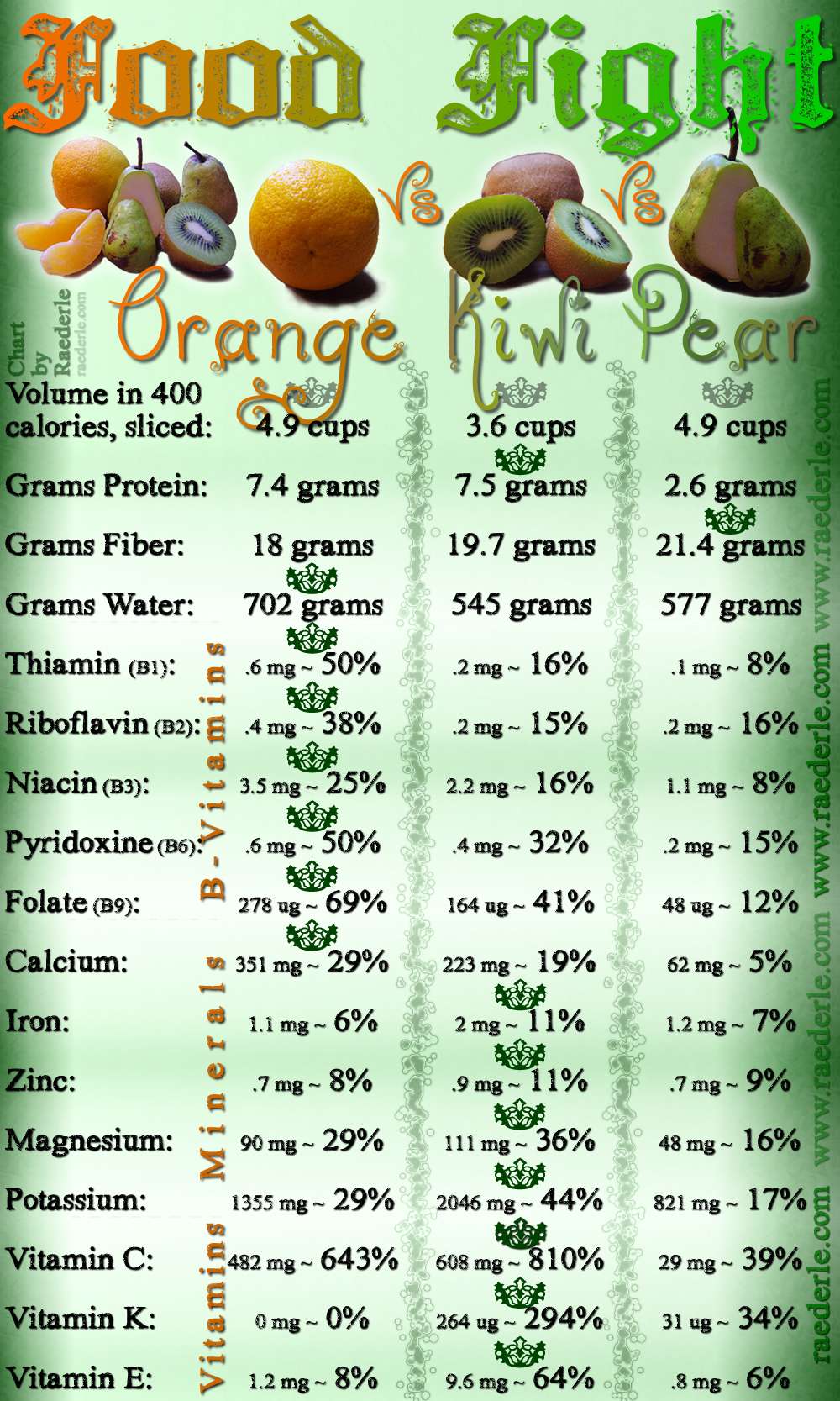
Below is a Food Fight chart where Kiwis, Oranges and Pears duke it out. Kiwis take the cake in Vitamin C and Pears pretty much just get their you-know-whats kicked.
Raederle's Food Fight Chart Comparing Kiwis Oranges and Pears
Feel free to pin the above image to your pinboards, share on facebook, and tweet about it on twitter.
Let's set the record straight once and for all: Oranges are great for B-vitamins and Calcium, but they are inferior to Kiwi fruits on many scores, such as Vitamin C, Vitamin E and Iron. Both kiwis and oranges are somewhat unusual among fruits for having a positive calcium to phosphorus ratio.

Growing Kiwis

Kiwis grow on vines. The typical kiwis seen in U.S. grocery stores are the green kiwi fruit and require a warm growing climate such as California or New Zealand. However, not all kiwi varieties require a warm climate.

Hardy Kiwis

The remarkable hardy kiwi vines can be grown in regions that get quite cold. The Actinidia Kolomikta is also called Arctic Beauty Kiwi, and can survive in areas as cold as zone 3. The vine grows about ten feet tall and three feet wide, sporting a lovely varied foliage with green and pink leaves.
The vine has whitish-yellow fragrant flowers in spring. Truly though, what sets this northern wonder apart is its sizable oblong leaves which are splashed with bright white and pink swaths along its edges. The effect is pronounced and stunning, even from a distance.
The colorful leaves are more varied when planted in full sun, but the vine can survive in a shaded location.
The fruit is much smaller than those that you see in the store. They average at the size of grapes.
The hardiest type is the Actinidia Kolomikata which does not need winter protection. The skin of the fruit is hairless: no scrubbing required. The flavor is similar, perhaps sweeter.
Plants should start to bear fruit in about one to two years after planting, and once established they can live for fifty years or more. Be sure to purchase a female plant as they are the only ones who can produce the fruit. You will also need the male plant to pollinate.
Hardy kiwi vines require at least one male pollinator for every eight females. Wind is the primary pollinator, so plant the male in the direction of the prevailing wind. Different cultivars bloom at different times; it is necessary to make sure the male and female bloom times overlap.
Hardy kiwis are very vigorous vines once they are established. Plant them with an adequately large structure to grow on. They can be finicky when young, so start with larger plants or pay them particular attention in the first couple years.
Hardy kiwi vines will grow in partial shade but produce better when in full sun. They tolerate a range of soils as long as there is drainage. For best growth and production, the vines appreciate regular and thorough watering.
Hardy kiwis are harvested in the fall when they begin to soften and sweeten. It can take up to eight years before hardy kiwis begin to fruit. Proper pruning and care can reduce this time to as little as three years. Once started, hardy kiwis can be prolific, producing up to 100 pounds of fruit from a single plant.

Kiwi History

Although Kiwifruit has been known for more than 700 years, it has only been available in the United States since the 1960s.
The history of the Kiwifruit began in the Yang-tse River Valley in China, known as “Yangtao.” The fruit Yangtao was considered a delicacy by the court of the great Khans who cherished its flavor and emerald color.
In the early 1900’s “Yangtao” seeds arrived in New Zealand and the fruit became known as “Chinese Gooseberry.”
In the 1960’s, it was shipped to the United States, where it was renamed “Kiwifruit” after New Zealand’s national bird the “Kiwi.”
Today, few in America call it the "kiwifruit" anymore. It is simply a kiwi, sharing its name with New Zealand's national bird.

Kiwis In The Wild

The brown, fuzzy kiwi fruits used to be found wild. The vines would be seen wrapped around trees.
In their natural habitat, the vines climb large trees up to 60 feet tall in the forests of China.

Conclusions About Kiwis

  • You can grow them anywhere, just buy the right variety.
  • Kiwis are good for an array of conditions such as diabetes, asthma, colon cancer, and vision problems.
  • Kiwis should be the new poster child for Vitamin C (not oranges).
  • Kiwis are a great travel food, and excellent for bulk purchase.
  • Kiwis are an appropriate fruit to eat in quantity on a regular basis.
Thanks for stopping by and checking this out. Come back again soon.
~ Raederle
PS: If you're starting to think that kiwis are so great that perhaps you could just live off of them, I'd like to tell you that you're nearly correct, but not quite. For details on that, read my article on The Fruitarian Diet.

Popular Posts This Month

Featured Post

Your Identity = Your Boundaries

  Your identity is the sum of your boundaries: the things to which you say “Yes,” and the things which you say “No.” What is your favorite f...