Thursday, September 6, 2012

Celery!

The Celery Song

Celery

Celery contains vitamin C and several other active compounds that promote health, including phthalides, which may help lower cholesterol, and coumarins, that may be useful in cancer prevention.
Celery And Leeks by Raederle
Celery is not just extremely low in calories: you actually burn more calories chewing celery than you are consuming by eating celery!

Celery's Health Benefits

Weight Loss

Celery juice and whole celery help burn fat. The chewing action releases hormones in the brain the reduce cravings. Research has shown that snacking on celery reduces the urge to eat unhealthy snack items.
Celery has a balance of minerals that is very hydrating. When thirsty, we often over-eat. Because celery quenches thirst on a level beyond just drinking water, it prevents over-eating causes by thirst.

Stress Reduction

Chewing reduces stress. This is why many people choose potato chips when they are stressed out. Choose celery instead. (Other great options include kale chips, chard stems, carrots, oranges and squash chips.)

Detox

Celery appears frequently in detox diet plans. This makes sense because celery has properties that aid digestion. Because celery is mildly sweet and contains sodium, it curbs cravings.
All raw fruits and vegetables have detoxing properties. Celery in particular is excellent because it provides a mild detox and highly balanced nutrition.

Insomnia

Celery is beneficial in cases of insomnia. Celery juice particularly is very calming to the nervous system. The high magnesium levels are soothing, and helpful to relaxation, and fully restful sleep.

Constipation

Raw celery aids constipation. The high fiber content "sweeps" the colon clean. Other helpful aids in the face of constipation include: psyllium husk, aloe juice, ginger, and turmeric.

Calicum

According to Hippocrates, the father of medicine, celery calms nerves. This may be contributed to by its high calcium content.
Celery is good for the kidneys and will eliminate the body's waste through the urine. The seeds, leaves, and edible root of the plant can all be used. Celery seed in particular is very high in calcium, and it is one of the few seeds commonly available that has a positive calcium to phosphorus ratio. A single tablespoon of celery seed provides 11% of the recommended daily need for calcium.

100 Calories of Celery

Ten large ribs of celery amounts to 102 calories. The calorie breakdown is 73.4% from carbs, 9.5% from lipids and 17.1% from protein. This is a highly ideal ratio if you're trying to lose weight or build muscle.
To maintain healthy muscle you only need 10% of your total calories to come from protein (on a 2000 calorie diet), and celery contains protein in a more digestable form than foods such as meat and beans. I explain this in detail in my article about protein, amino acids and enzymes.
Ten ribs of celery (102 calories) provides roughly 20% of all of your nutrient needs for an entire day, including the following RDA values:
12% B1 (thiamine), 33% B2 (riboflavin), 15% B3 (niacin), 31% B5 (pantothenic acid), 36% B6 (pyridoxine), 58% B9 (folate), 20% vitamin A, 26% vitamin C, 12% vitamin E, 208% vitamin K, 26% calicum, 7% iron, 23% magnesium, 35% potassium, 5% selenium, 34% sodium and 10% zinc.
All of that in just 100 calories!

Potassium

Celery has a lot of potassium. Potassium is an electrolyte that is good for maintaining a healthy nervous system. It is vital for proper brain function and normal muscle growth. It lowers blood pressure and helps balance normal water levels in your body. Lack of potassium can cause heart problems, fatigue, and dry skin. Coconut water from young Thai coconuts is extremely high in potassium content as well.

Vitamin K

Celery is rich in vitamin K, which will help to suppress the appetite. Vitamin K also helps to form normal blood clots, i.e. it's the vitamin that stops you from bleeding to death.
Adults over age 50 should increase the vitamin K intake, as it aids in making essential bone proteins, preventing bone fractures and osteoporosis. A lack of vitamin K can cause liver problems, excessive bruising and bleeding.

Coumarins

Celery contains phytochemical compounds known as coumarins. Studies have shown that coumarins are effective in cancer prevention and capable of enhancing the activity of certain white blood cells. Coumarin compounds also lower blood pressure, tone the vascular system, and are possibly effective when used in cases of migraines.

After-Workout Drink

Due to the high levels of potassium and sodium, when celery-based juices are consumed after a workout they serve as great electrolyte replacement drinks. Studies have also shown that celery may help to lower cholesterol and prevent cancer by improving detoxification. Celery extract that contains 85% 3nB, has been shown to be effective in the treatment of "rheumatism". That is, celery is effective against arthritic and muscular pains.

Vitamins

Celery provides an excellent source of vitamin C and fiber. It is a very good source of folic acid, potassium, and vitamins B1 and B6. Celery also offers a good source of vitamin B2 and calcium. Even though celery contains more sodium than most other vegetables, the sodium is offset by it's high levels of potassium. Studies have shown that the sodium content of celery does not bother even the most salt-sensitive individuals. And yet, if you ate enough celery, you could meet all of your sodium needs on celery alone.

Vitamin C

Celery is an excellent source of vitamin C, a vitamin that helps to support the immune system. Vitamin C-rich foods like celery may help reduce cold symptoms or severity of cold symptoms; over 20 scientific studies have concluded that vitamin C is a cold-fighter.
Vitamin C also prevents the free radical damage that triggers the inflammatory cascade, and is therefore also associated with reduced severity of inflammatory conditions, such as asthma, osteoarthritis, and rheumatoid arthritis.
As free radicals can oxidize cholesterol and lead to plaques that may rupture causing heart attacks or stroke, vitamin C is beneficial to promoting cardiovascular health. Owing to the multitude of vitamin C's health benefits, it is not surprising that research has shown that consumption of vegetables and fruits high in this nutrient is associated with a reduced risk of death from all causes including heart disease, stroke and cancer. For more about vitamin C, read this article containing ten different ways to get a full day's supply of vitamin C from whole foods.

Blood Pressure

Celery's potential for reducing high blood pressure has long been recognized by Chinese medicine practitioners, and Western science researchers may have recently identified one reason why: Phthalides.

Phthalides

Celery contains active compounds called phthalides, which can help relax the muscles around arteries and allow those vessels to dilate. With more space inside the arteries, the blood can flow at a lower pressure.
Phthalides also reduce stress hormones, one of whose effects is to cause blood vessels to constrict. Research has shown that celery can rapidly reduce blood pressure upon consumption.

Cholesterol

In studies of animals specially bred to have high cholesterol, celery's cholesterol-lowering activity has been demonstrated. In eight weeks, aqueous solutions of celery (like celery juice) fed to specially bred high cholesterol animals significantly lowered their total cholesterol by increasing bile acid secretion.

Uses

Grated raw celery can be used on swollen glands.
Celery is used in aromatherapy and other traditional ways of healing, like Ayurveda.
In Japan, rheumatic patients are sometimes put on a celery-only-diet.
As stated before, celery is also a useful component of a detox diet.

Buying & Storing Celery

Season

Available year-round in the U.S.

Buying

Look for firm, tight bunches with healthy leaves. Avoid bruised celery as it will taste bitter. When celery (or most any plant) is damaged, it releases bittering agents to fend off bugs.

Storing

Refrigerate in a plastic bag (preferably a green bag) and place in the crisper for up to two weeks. If the ribs are wilted, separate the ribs and place them in a bowl of ice water for several minutes before use.
You can also store upright in a vase with a little water or a wet towel at the bottom of the vase inside or outside the fridge.

Growing & Eating Celery

Preparation

Wash thoroughly, as the bunch attracts sand. Celery can be boiled, braised, eaten raw or steamed. I recommend enjoying it raw to get the full benefits. Vitamin C and many other compounds will be entirely ruined by heating celery to high temperatures.
Celery is also good to add to fruit and vegetable smoothie. Click here to check out a smoothie recipe including celery (which includes a how-to video).

Good Food Combinations

Celery is good to combine with just about anything.
Flavor wise, celery goes great with fatty foods such as avocado, almonds and walnuts. Also, curry, celery seeds, dill, fennel, lemon, nutmeg and parsley are great with celery.
In terms of digestive combinations, celery is one of the only foods that can be combined with fruit without causing a digestive upset. For more about healthy digestive combinations, read my food pyramid page.

Speaking Botanically About Celery

Celery is a biennial vegetable (meaning it has a normal life cycle of two years) that belongs to the Umbelliferae family, whose other members include carrots, fennel, parsley and dill. While most people associate celery with its prized stalks, its leaves, roots and seeds are also used as a food and seasoning as well as a natural medicinal remedy.
Apium graveolens is a plant species in the family Apiaceae commonly known as celery (var. dulce) or celeriac (var. rapaceum) depending on whether the petioles (stalks) or roots are eaten.
Apium graveolens is used around the world as a vegetable, either for the crisp petiole (leaf stalk) or the fleshy toproot. The root of the celery is also often eaten, which tastes similar to parsnip. Celery root is sometimes grated for use in raw recipes imitating rice.

Celery Seeds & Celery Salt

In temperate countries, celery is also grown for its seeds. The seeds are actually a very small fruit. These "seeds" yield a valuable volatile oil used in the perfume and pharmaceutical industries. They also contain an organic compound called apiol.
Celery seeds can be used as flavouring or spice, either as whole seeds or ground and mixed with salt, as celery salt.
Celery salt can also be made from an extract of the roots.
There are many versions of celery salt, but I make my own at home like this:
1. Slice up several bunches of celery finely.
2. Dehydrate celery slices at 105 degrees F overnight or however long it takes for them to become completely dry. Flip pieces as needed.
3. Blend dehydrated celery flakes with celery seeds (to taste).
4. Add dulse flakes to taste. (Dulse is a salty sea vegetable that is also very good for your health.)
5. Store in a glass spice jar and use as you would use regular sea salt.
The celery salt I make can be referred to as a "Veggie Salt" because all of the sodium content comes from whole foods. Veggie salts are much healthier than any other salt, including sea salt, because veggie salts contain other minerals besides sodium in plenty. While sea salt contains some other minerals, it doesn't really compare to that which you'll get from dehydrated celery, celery seeds and dulse.

Growing Celery From Grocery Store Celery

How To Grow Celery From Store Bought by Raederle

World-wide Cuisine: Celery

Celery salt is used as a seasoning, in cocktails (notably to enhance the flavour of Bloody Mary cocktails), and in Old Bay Seasoning.
Celery, onions, and bell peppers are key in Louisiana Creole and Cajun cuisine. Celery, onions, and carrots make up the French mirepoix, often used as a base for sauces and soups. Celery is a staple in many soups, such as chicken noodle soup.

Celery On The Raw Diet

Celery is important for any raw vegan who is avoiding consuming excess salt in the crystallized form that is added to food. Getting enough sodium is vitally important to hydration and overall health, although most Americans get too much sodium in their diet.
In an episode of my radio show I mention a woman who went raw and actually fainted from lack of sodium.
Most raw foodies add sea salt to their salads to their own taste, but some 'natural hygienists' prefer to get all nutrients from plants. If you're going to seek out sodium exclusively from plants then I recommend listening to the episode of my show I linked in the previous paragraph. In that episode I explain precisely how to get enough sodium from whole foods alone.
Thanks for reading!
Article by Raederle Phoenix
Originally written in 2009-2010, updated in January 2012 and September 2012

What is Live Food?

Eat Live, Live Well

Our first episode: an introduction, by Raederle and Jay. Click here to open the audio for the show. While you are listening, follow along on the outline below. (Research has shown that reading an outline while listening helps you retain more information. Try it for yourself!)

[The Cause & The Cure]

In the past I – Raederle – have struggled with the following: acid reflux, fatigue, bad breath, flaky scalp, mood swings, itchy eyes, migraines, depression, acne – and more.
You probably have or will experience many of these during your lifetime as well.
Diet can be the cause and the cure.
This show is about providing information to empower you with the ability to heal yourself.

[Live Food]

  • Live food is refers to raw food – food that is not processed; food that is not cooked. If you've ever eaten a plain raw apple, carrot, stick of celery or slice of pineapple then you have eaten raw food.
  • Raw foods are “alive” because certain aspects of the food “die” when cooked.
  • Enzymes are denatured – or “killed” – through heating foods over 105 degrees Fahrenheit.
  • Technically some are denatured at 105 degrees and some can withstand up to 118 degrees.

[Enzymes]

  • All of the work being done inside any cell is being done by enzymes.
  • The cytoplasm of a cell can have a thousand different types of enzymes at any given time.
  • Enzymes are chemical-reaction machines.
  • Enzymes are made from amino acids. The chain of amino acids folds into a unique shape – a unique enzyme.
  • The sugar maltose is made from two glucose molecules bonded together. The enzyme maltase is shaped in such a way that it can break the bond and free the two glucose pieces. The only thing maltase can do is break maltose molecules.
  • Lactose intolerance is caused by the inability to digest lactose. Lactase – the enzyme that breaks apart lactose into glucose – is already present in milk before it is pasteurized. Many lactose-intolerant people can drink unpasteurized – raw – milk.
  • When food is heated, the enzymes are denatured and no longer work. This creates a demand on our bodies to create enzymes.
  • When digesting difficult cooked/processed foods our body will need to convert metabolic enzymes into digestive enzymes.
  • A metabolic enzyme is about one-eighth as strong as a digestive enzyme. Thus, we'll lose eight enzymes in our liver, kidneys or heart to make one digestive enzyme in our stomach.

[Protein]

  • A protein is any chain of amino acids. An amino acid is a small molecule that acts as the building block of any protein.
  • As far as your body is concerned there are two different types of amino acids: essential and non-essential.
  • Non-essential amino acids are amino acids that your body can create out of other chemicals found in your body. 
  • Essential amino acids cannot be created, and must be obtained through food.
I grew up on a diet that was almost wholly cooked/processed. I had milk on plain unsweetened wheat-based cereals for breakfast or eggs on buttered toast. For lunch I ate yogurt, ramen noodles, more cereal or leftovers from the previous night's dinner. For dinner my family aimed to serve one portion of meat, one or two cooked vegetable options and potato or pasta.
It was just as the old food pyramid suggested – lots of breads, pastas and starch, a little vegetable, a little meat, a little dairy and the occasional fruit.
As a toddler I was always tired. As a pre-teen I had constant infections. As a teenager I began to get daily acid reflux, migraines and anxiety attacks. Doctors blamed this on genetics and prescribed pills for me that made me nauseated or gave me headaches.
My husband – Jay – has experienced food-related problems as well.

[Complete Protein]

  • Misconception: One must eat certain kinds of food, such as meat, in order to get a "complete protein."
  • The myth that vegetables have incomplete proteins was popularized by a book in the 1970s called "Diet For A Small Planet" by Frances Moore Lappé. The same author released another book with the same title in the 1980's where she admitted she was wrong. In other words, the person who came up with the idea of a "complete protein" recanted ten years later.
  • A "complete" protein is defined by having all of the essential amino acids. 
  • All vegetables, even a cucumber, have all essential amino acids that make up a so-called "complete" protein.
  • As long as you're eating enough calories, you're eating enough protein.
  • The World Health Organization recommends that 5% to 10% of the calories we consume should come from protein.
  • The calories in a vegetable average 22% from protein, 10% from fat and 68% from carbohydrate.
  • When you consider herbivores in the wild, such as gorillas and elephants, raw fresh vegetables is the base of their diet, and is enough for them to grow stronger, larger and healthier than humans.

[Celery]

  • Celery calorie breakdown: 9.2% from fat, 17.2% from protein and 73.6% from carbs. 
  • Celery is typical for a vegetable.
  • Celery takes more calories to chew it than it provides. It's a great weight loss food.
  • Chewing celery itself combats stress by releasing comforting hormones in the brain.
  • Celery is also great for hydration. It has high water content and some structured sodium.
  • Celery alone is plenty of protein from a quantitative standpoint.

[Watercress]

  • Watercress calorie breakdown: 7.9% from fat, 42.1% from carbs and a whopping 50% from protein.
  • Compare to beef: 41.7% calories from protein.
  • Compare to kidney beans: 23.7% calories from protein.
  • By calorie, watercress has more protein than beef, and more than twice as much protein than most beans.
  • We only need 5% to 10% of our calories to come from protein. (Depending on how active we are and how many total calories we eat.)

[Protein & Digestion]

  • The protein in beans, meat and nuts is digested differently than the protein in vegetables.
  • The protein in watercress is easily digested. There is fiber, water and minerals that work with the protein in your body.
  • In raw plant foods, such as watercress, all the enzymes are active and ready to be catalysts for chemical reactions.
  • When you're not stealing metabolic enzymes from your organs to help you digest your food, you have a lot more energy.
  • The dense fat and denatured protein in many cooked foods is so arduous to digest that you spend hours trying to digest it.

[Hormonal Balance]

  • Quick digestion is vital to hormonal balance.
  • A hormonal imbalance leads to depression, insomnia, fatigue, anxiety, inability to gain muscle and difficulty losing weight.
  • Hormonal functions are affected by every aspect of our lives: stress levels, when we sleep, how long we sleep, etc.
  • Insulin levels go up when we eat, and insulin is a hormone.

[Insulin & Growth Hormone]

  • We've been told that small meals throughout the day is good – that it will keep our blood sugar steady.
  • If a hormonal imbalance is already present, this may create more trouble.
  • When insulin is up our growth hormone is down.
  • Growth hormone is what allows us to build muscle and burn fat.
  • If you're still digesting when you begin to exercise and/or start eating immediately afterward then you don't produce much or any growth hormone. Therefor you don't build muscle or burn fat effectively.
  • This topic is something that Dr. Ritamarie discusses in detail in her literature.

[Sensitive Digestion]

  • If you have a sensitive digestion then exercising while you're still trying to digest food can upset the entire body.
  • Exercising during digestion may cause stitches in your sides, sudden fatigue, dizziness, nausea or acid reflux.
  • Drawn-out digestion can block muscle production, hinder weight loss, cause fatigue and lessen nutrition extraction.
  • When we fail to digest something within our stomach, further digestion in our intestines is not probable.
  • Instead of consuming the food ourselves, bacteria and parasites eat it instead.

[Bacteria/Parasites/Flora & Intestinal Health]

  • When you take antibiotics or come in contact with strong molds or bacteria then our helpful flora is killed off in droves.
  • Healthy flora is often replaced with the bad bacteria, or an overgrowth of bacterias that were good in small amounts. (This often happens with yeast, which becomes a candida problem.)
  • A hundred years ago we could have had the healthy bacteria put back into our bodies by drinking from a river or well or consuming some dirt on a plant.
  • If your mother didn't have healthy flora then neither did you when you were born. This is why more and more children today have such a weak immune system. (I was one of those babies.)

[Flora & B-Vitamins]

  • Healthy flora is important for absorption of b-vitamins which regulate our nervous system.
  • Without adequate b-vitamins we may not be able to smell well, think clearly or feel happiness.
  • The brain is a mass of nerves, and without b-vitamins it doesn't function correctly.
  • Lack of b-vitamins can result in schizophrenia.
  • I've personally encountered many people who cured their schizophrenia by taking b-vitamin supplements.
  • However, if you have healthy flora and a healthy diet, getting enough b-vitamins is easy without supplements.

[Quickly Digesting Foods]

  • Raw fruit and vegetables digest quickly.
  • Melons only take about twenty minutes to digest, as they are primarily water.
  • Most raw fruits take thirty to fifty minutes to digest.
  • Fatty fruits are an exception. Coconuts, olives and avocados take several hours.
  • Most raw vegetables take an hour or two to digest. Vegetables take longer is because of vegetable fiber which must be pulled apart from the minerals and sugars present in the vegetable.
  • Beans, meat, dairy, eggs, fish and most cooked foods take a bare minimum of three hours to digest.
  • These amounts are based on a healthy digestive system. Many people still have food inside their intestines from three days ago.

[Fiber]

  • The fiber is great – its like an army of little brooms coming to clean your intestines.
  • People with serious conditions may want a faster approach.
  • The fastest and most effective digestion possible will occur when drinking fresh home-made raw juice.
  • Juice is the essence of plants minus the fiber.
  • The difference between a juicer and a blender is that the juicer removes the fiber from the food and puts it into a pulp bin separate from the juice.
  • An inexpensive centrifuge juicer can cost as little as $70.
  • We own the L-equip XL, a centrifuge juicer that cost about $100 dollars.
  • A centrifuge juicer is great for making juice from carrots, apples, celery, citrus, tomatoes, chard stems and beets.
  • We also own the Omega 8005, a masticating juicer, which uses a mashing-squishing action instead of spinning blades.
  • The Omega 8005 cost us about $250 dollars.
  • A masticating juicer is excellent for juicing spinach, lettuce, wheatgrass – any leafy green – and it also can do carrots and celery well but it is much slower with these foods than our centrifuge.

[Juice Recipes]

Centrifuge Juicer:
  • 5 carrots
  • 5 celery sticks
  • 2 tomatoes
  • 1-2 lemons
You may also add half a beet or a whole beet, chard stems or apples.
This juice is loaded with nutrition, providing plenty of beta-carotene which we turn into vitamin A within our bodies, a full day's supply of vitamin C and in 250 calories this juice provides 8 grams of protein.
Masticating Juicer:
  • 1 head of romaine lettuce
  • 1 bunch of parsley or cilantro
  • 1-2 lemons
In just 150 calories this juice provides the full day's supply of vitamin A, vitamin C, vitamin K, folate, half our needs for the array of b-vitamins excluding B12, as well as about a third of our needs for minerals. In those 150 calories is 11 grams of protein.
It would take over 200 calories of sausage to get 11 grams of protein. But you'd also get 18 grams of toxin-laden fat and virtually no nutrition except some zinc. We'll talk about why I call it "toxin-laden fat" in a later episode.
You can check out more juice recipes here.

[Final Words]

  • It's our aim to empower you to be happy and healthy.
  • If you're feeling inspired or empowered right now, then we'll consider this a job well done.
  • If you're feeling staggered or overwhelmed, then take a break, drink some water and do something fun.
Thanks for listening to Eat Live; Live Well with Raederle and Jay.
If you have a heath or fitness question you'd like us to answer visit the contact page.
~ Raederle & Jay

Tuesday, September 4, 2012

Kiwi Fruit

Kiwi Fruit Photographed by Raederle Phoenix 2012

Buying Kiwis

Organic kiwis are now available widely in the United States, and conventional ones are virtually everywhere. Only in remote places in Kansas and other mid-western states have I been unable to find them.
Kiwis travel well, so if you're going somewhere remote, take some with you. They are easy to squash, but they don't ripen too fast, so you can purchase them very firm. Firm kiwis will keep well over a week without going too soft (at temperatures below 80 degrees F).
Because they do well without refrigeration, I enjoy ordering organic kiwis by the box through my local co-op market.

Kiwifruit Flavor & Texture

I've seen many creative descriptions. Such as, "The fruit has a sweet taste, similar to a mixture of banana, pineapple and strawberry," and "They have a kinda melon taste with strawberry mixed in," and "Tastes like a cross between a strawberry, banana and a nectarine."
In my own opinion, it is similar in texture to a dragonfruit. The flavor, when somewhat under-ripe (the way I like them best), is somewhat like a mild lemon crossed with a banana and a small yellow mango. When they are ripe or over-ripe they taste more melon-like.
Most people seem to like them either sour (not quite ripe) or sweet (ripe and soft), but not the other way. When trying one for the first time I recommend trying both a firm kiwi and a soft one. The flavor change is significant.

Eating Kiwis

It is generally assumed that the fuzzy brown kiwi skin must be peeled. If you're eating six kiwis a day (which sometimes I do), this is a tiresome process. Instead, I scrub the fuzz off of the kiwi skin. I count to eight on each "plane" of of the kiwi: the top surface, the back surface, the two sides, the front butt and the back butt. (I have no idea how better to describe the six "sides" of the kiwi! Ideas anyone?)
The difference this quick vigorous process makes is very significant. The texture becomes more like an apple skin. It is even visible as seen in the photos below.
Kiwi Skin Scrubbed versus Not Scrubbed Photographed by Raederle 2012
Scrubbing each plane of the kiwi takes very little time — roughly amounting to three seconds per plane, which is 18 seconds per kiwi. These fast firm motions take off everything, especially if you are patient enough to scrub even longer.
You don't have to buy a special brush. Use any firm-bristle brush you choose: a finger-nail brush will work well. I keep a dish-scrubbing brush aside near the sink for the purpose of scrubbing fruits and vegetables.

Kiwi Health Benefits

Kiwis Prevent Vision Loss
A series of studies published by the Archives of Ophthalmology have shown that consuming three or more servings of fruit per day (including kiwi fruits) can reduce the risk of developing an eye-related disease called ARMD (the primary cause of vision impairment in adults) by 36%, if compared to people who only consume one-and-a-half servings of fruit per day. This is attributed to the phytochemical lutein found in kiwis.
Kiwis Have Fiber
While kiwis are not special in their fiber content (almost all fruits have great fiber content), the benefits of fiber should not be over looked.
Dietary fiber helps improve diseases such as diabetes and colon cancer. Fiber slows the absorbtion of sugar, keeping the sugar levels in the body consistent. Fiber binds to toxic compounds in the colon and helps us expel them.
Fiber has been proven to reduce cholesterol levels, improving the conditions of patients with cardiovascular diseases and lowering the probability of heart attacks.
Animal products such as meat, milk and cheese have little to no fiber at all. Juices and drinks do not have fiber. The fiber in cooked food is altered and not as effective at helping things move through the colon. The best fiber comes from raw fruits and vegetbales, such as the kiwi.
Kiwis Fight Asthmatic & Allergic Reactions
Researchers at South Korea’s Seoul National University administered kiwifruit extract to mice that were later exposed to allergens, then monitored for roughly three weeks. Compared to a control (placebo) group, the kiwi-fed mice enjoyed a 47 percent decline in asthmatic symptoms – plus a 48 percent reduction in white blood cell counts (which marshal in excess among asthmatic and allergy patients). Kiwi’s powerful enzyme – actinidin – may play a role.
Studies in Italy performed on 6 and 7 year old children have demonstrated health benefits to the respiratory tract. Children that were fed 5 to 7 portions a week of citrus and kiwi had 44% less wheezing compared to children eating less than one portion per week.
Shortness of breath was reduced by 32%, night time coughing by 27%, severe wheezing by 41%, chronic coughing by 25%, and running nose by 28%.
Some attribue these benefits to the "flavonoids" present in the fruit which protect our cells from oxidative damage.

Kiwi Fruit Versus Oranges Versus Pears

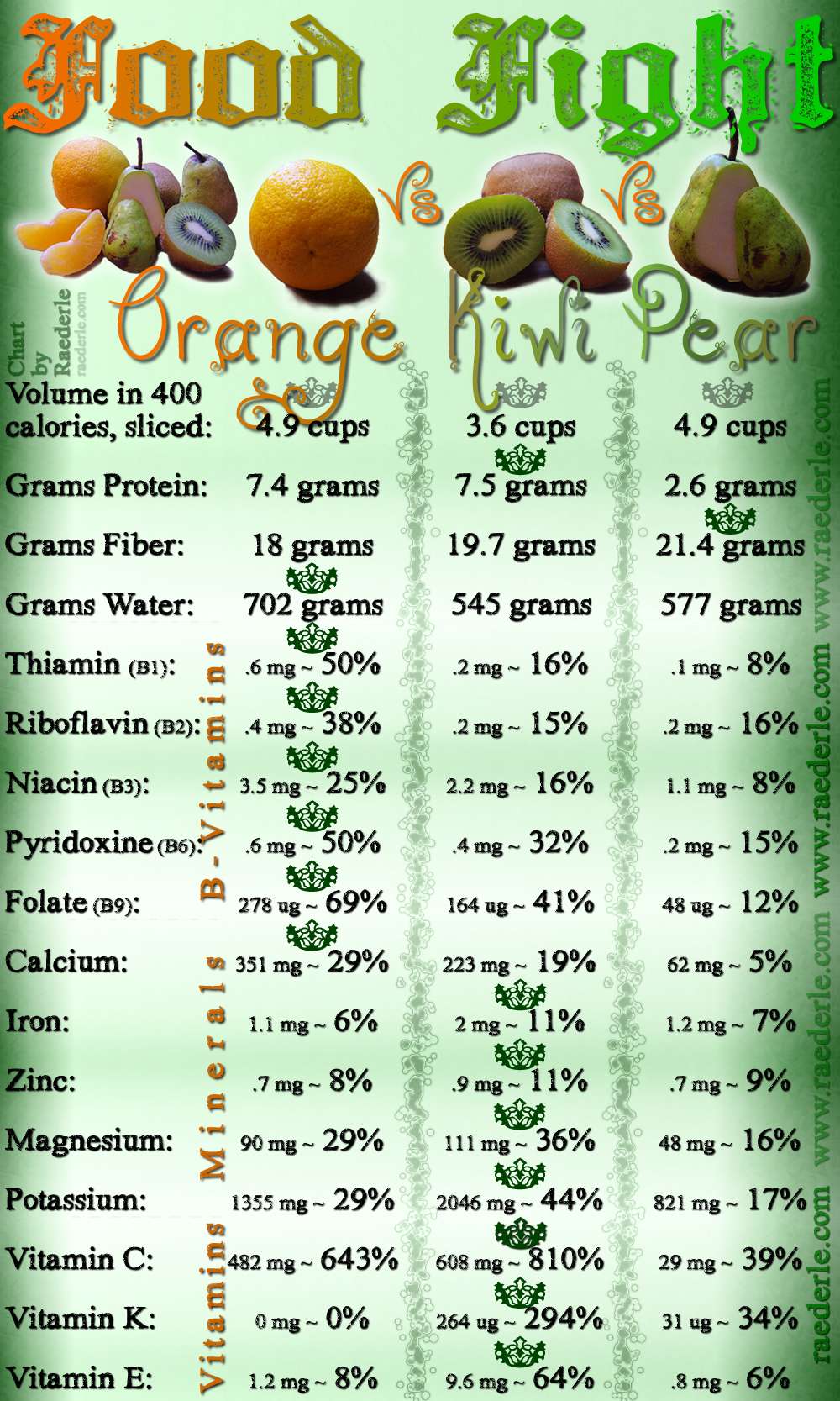
Below is a Food Fight chart where Kiwis, Oranges and Pears duke it out. Kiwis take the cake in Vitamin C and Pears pretty much just get their you-know-whats kicked.
Raederle's Food Fight Chart Comparing Kiwis Oranges and Pears
Feel free to pin the above image to your pinboards, share on facebook, and tweet about it on twitter.
Let's set the record straight once and for all: Oranges are great for B-vitamins and Calcium, but they are inferior to Kiwi fruits on many scores, such as Vitamin C, Vitamin E and Iron. Both kiwis and oranges are somewhat unusual among fruits for having a positive calcium to phosphorus ratio.

Growing Kiwis

Kiwis grow on vines. The typical kiwis seen in U.S. grocery stores are the green kiwi fruit and require a warm growing climate such as California or New Zealand. However, not all kiwi varieties require a warm climate.

Hardy Kiwis

The remarkable hardy kiwi vines can be grown in regions that get quite cold. The Actinidia Kolomikta is also called Arctic Beauty Kiwi, and can survive in areas as cold as zone 3. The vine grows about ten feet tall and three feet wide, sporting a lovely varied foliage with green and pink leaves.
The vine has whitish-yellow fragrant flowers in spring. Truly though, what sets this northern wonder apart is its sizable oblong leaves which are splashed with bright white and pink swaths along its edges. The effect is pronounced and stunning, even from a distance.
The colorful leaves are more varied when planted in full sun, but the vine can survive in a shaded location.
The fruit is much smaller than those that you see in the store. They average at the size of grapes.
The hardiest type is the Actinidia Kolomikata which does not need winter protection. The skin of the fruit is hairless: no scrubbing required. The flavor is similar, perhaps sweeter.
Plants should start to bear fruit in about one to two years after planting, and once established they can live for fifty years or more. Be sure to purchase a female plant as they are the only ones who can produce the fruit. You will also need the male plant to pollinate.
Hardy kiwi vines require at least one male pollinator for every eight females. Wind is the primary pollinator, so plant the male in the direction of the prevailing wind. Different cultivars bloom at different times; it is necessary to make sure the male and female bloom times overlap.
Hardy kiwis are very vigorous vines once they are established. Plant them with an adequately large structure to grow on. They can be finicky when young, so start with larger plants or pay them particular attention in the first couple years.
Hardy kiwi vines will grow in partial shade but produce better when in full sun. They tolerate a range of soils as long as there is drainage. For best growth and production, the vines appreciate regular and thorough watering.
Hardy kiwis are harvested in the fall when they begin to soften and sweeten. It can take up to eight years before hardy kiwis begin to fruit. Proper pruning and care can reduce this time to as little as three years. Once started, hardy kiwis can be prolific, producing up to 100 pounds of fruit from a single plant.

Kiwi History

Although Kiwifruit has been known for more than 700 years, it has only been available in the United States since the 1960s.
The history of the Kiwifruit began in the Yang-tse River Valley in China, known as “Yangtao.” The fruit Yangtao was considered a delicacy by the court of the great Khans who cherished its flavor and emerald color.
In the early 1900’s “Yangtao” seeds arrived in New Zealand and the fruit became known as “Chinese Gooseberry.”
In the 1960’s, it was shipped to the United States, where it was renamed “Kiwifruit” after New Zealand’s national bird the “Kiwi.”
Today, few in America call it the "kiwifruit" anymore. It is simply a kiwi, sharing its name with New Zealand's national bird.

Kiwis In The Wild

The brown, fuzzy kiwi fruits used to be found wild. The vines would be seen wrapped around trees.
In their natural habitat, the vines climb large trees up to 60 feet tall in the forests of China.

Conclusions About Kiwis

  • You can grow them anywhere, just buy the right variety.
  • Kiwis are good for an array of conditions such as diabetes, asthma, colon cancer, and vision problems.
  • Kiwis should be the new poster child for Vitamin C (not oranges).
  • Kiwis are a great travel food, and excellent for bulk purchase.
  • Kiwis are an appropriate fruit to eat in quantity on a regular basis.
Thanks for stopping by and checking this out. Come back again soon.
~ Raederle
PS: If you're starting to think that kiwis are so great that perhaps you could just live off of them, I'd like to tell you that you're nearly correct, but not quite. For details on that, read my article on The Fruitarian Diet.

Monday, September 3, 2012

Fruitarian Diet | Is It Nutritionally Sound?

Photo by Raederle, June 2012

What is a Fruitarian?

The web definition for fruitarian says that a fruitarian is someone who eats only fruit. I've met some people who call themselves fruitarians and most of them say they eat "about 90% fruit." That sounds more reasonable to me. But, one way or another, I have this burning question:
Is it possible to live entirely on fruit?
To find the answer I've finally done the number punching.
Below are some examples of a diet that meets standard nutritional recommendations.

Nutritionally Complete Fruitarian Diet: Day Sample #1

  • 6 green kiwi
  • 3 cups pineapple
  • 6 medium bananas
  • 6 raw fresh figs
  • 6 cups cantaloupe
  • 1 mango
  • 1 pomegranate
  • 3 cucumber
  • 2 cups papaya
  • 15 tablespoons goji berries (nearly 1 cup)
  • 1 grapeftuit
  • 4 oranges
  • 1 avocado

Total calories: 3325

Calorie breakdown: 84.2% from carbs, 10.5% from lipids and 5.3% from protein

Meets nutritional needs for B1-B9, A, D, E, K, Calcium, Copper, Iron, Magnesium, Manganese, Phosphorus, Potassium, Selenium, Zinc, Omega-3 and Omega-6. This also provides 54 grams of protein, which is more than enough for the average adult.

This does not meet nutritional needs for sodium. It only meets 18% of the nutritional need for sodium. A half teaspoon of sea salt would provide the rest of the needed sodium. This could be added to the grapefruit, or to a smoothie containing the bananas and goji berries, or to a dish containing diced cucumber and avocado.
The above possibility uses nearly a full measuring cup of goji berries, which is to meet the nutritional needs for selenium. I wanted to see if selenium could be met with just fruit, but without the use of goji berries. Hence the fruit plan below:

Nutritionally Complete Fruitarian Diet: Day Sample #2 (Without Goji Berries)

  • 3 cups shredded raw coconut meat
  • 4 medium starfruits (carambola)
  • 6 cups honeydew melon
  • 5 cups mulberries
  • 4 medium zucchini
  • 4 cups blackberries
  • 5 cups strawberry halves
  • 2 bananas
  • 2 mangoes
  • 4 cups papaya

Total calories: 3133

Calorie breakdown: 67.5% from carbs, 26.2% from lipids and 6.3% from protein

Meets nutritional needs for B1-B9, A, D, E, K, Calcium, Copper, Iron, Magnesium, Manganese, Phosphorus, Potassium, Selenium, Zinc, Omega-3 and Omega-6. This also provides 61 grams of protein, which is more than enough for the average adult.

This does not meet nutritional needs for sodium. It only meets 30% of the nutritional need for sodium. A half teaspoon of sea salt would provide the rest of the needed sodium.
I think the two above examples prove that it is possible to live off of fruit according to RDA standards. However, as I've stated, I don't think it would be wise to live fully off of fruit. For example, what about chlorophyll? Evidence shows many benefits of consuming chlorophyll which is primarily found in leafy greens.
Let's now see how low we can get the calories by including just a couple key foods to provide some of the tough minerals like calcium, iron, zinc and selenium.

Nutritionally Complete Nearly Fruitarian Diet: Day Sample #3

  • 4 cups raw fresh organge juice
  • 2 pink grapefruits
  • 2 yellow bell peppers
  • 2 red bell peppers
  • 2 cups blackberries
  • 2 medium zucchini
  • 1 cucumber
  • 6 cups watermelon
  • 10 olives
  • 5 cups blueberries
  • 2 cups red or white currants
  • 1 avocado
  • 2 cups fresh basil leaves
  • .5 Brazil nut
  • 10 cups watercress

Total calories: 2218

Calorie breakdown: 77.9% from carbs, 14.6% from lipids and 7.5% from protein

Meets nutritional needs for B1-B9, A, D, E, K, Calcium, Copper, Iron, Magnesium, Manganese, Phosphorus, Potassium, Selenium, Zinc, Omega-3 and Omega-6. This also provides 54.4 grams of protein, which is more than enough for the average adult.

This does not meet nutritional needs for sodium. It only meets 44% of the nutritional need for sodium. A half teaspoon of sea salt (or less) would provide the rest of the needed sodium.
The above example is to show how an almost entirely fruit diet can meet nutritional recommendations near 2000 calories instead of 3000 calories. Being flexible enough to eat watercress, basil and half a Brazil nut makes the difference of 1000 calories.
All three of the above examples would require living off the land or having a lot of money, as you may have noticed. Can we improve that perhaps?

Nutritionally Complete Nearly Fruitarian Diet: Day Sample #4

  • 1 cup shredded raw coconut meat
  • 6 cups honeydew melon
  • 3 red bell peppers
  • 6 kiwi
  • 4 cucumber
  • 2 oranges
  • 1 pomegranate
  • 2 tablespoons flax seed
  • .5 Brazil nut
  • 4 cups chopped kale
  • 6 chard leaves

Total calories: 1860

Calorie breakdown: 71.2% from carbs, 21% from lipids and 7.9% from protein

Meets nutritional needs for B1-B9, A, D, E, K, Calcium, Copper, Iron, Magnesium, Manganese, Phosphorus, Potassium, Selenium, Zinc, Omega-3 and Omega-6. This also provides 48.7 grams of protein, which is enough for the average adult.

This does not meet nutritional needs for sodium. It only meets 67% of the nutritional need for sodium. A quarter teaspoon of sea salt would provide the rest of the needed sodium.
To buy the above at my local grocery store, entirely organic, would cost around... $37! So, yes, it makes a lot more sense to get a siginificant amount of nutrition from seeds and vegetables. Of course, if you have an orange tree, a fig tree, an apple tree, etc, it makes most sense to utilize the wonderful source of fresh fruit.
In my meal plans I illustrate a nutritionally complete raw vegan diet that averages 40% from fruit, 40% from vegetables and 19% from seeds and 1% from nuts. Except, of course, Nut-Free Delectable Delights 7-Day Meal Plan doesn't contain nuts at all.
Personally, in cutting back my own cost of living and in searching for the optimal raw vegan diet, I find that this balance (40% fruit, 40% vegetable, 19% seed, 1% nuts) works best. This balance is by calorie, not by volume. So I get about 40% of my calories from fruits, 40% of my calories from vegetables, 19% of my calories from seeds and 1% of my calories from nuts.
This works out about like this: 69% calories from carbs, 20% calories from fats, 11% calories from protein.
Note that this is not far off from the 80-10-10 diet. I could eat less fat in proportion to how much carbs and protein I ate if I could afford to eat more fruit, less seeds and a higher calorie diet. Of course, it also helps how you buy your fruit.
Photo by Raederle, April 2012

Buying In Bulk

My husband and I buy bananas by the box, getting 40lbs of organic bananas (75 bananas) for $25.00. That is 33 cents per banana or 62 cents a pound.
We also regularly buy a box of 72 organic oranges which costs us $45, and boxes of kiwis as well. Kiwis are great because they keep on the counter a long time. Oranges are great because they keep well in the fridge for a long time. Bananas are great because they can be frozen, consumed as smoothies or ice-cream and they can also be dehydrated. These three fruits are very ideal for bulk purchases even for small families.
We also buy nori sheets in bulk, a dried sea vegetable, with the end price being about 30 cents per nori sheet. If you buy them by the ten pack at the store you end up paying 45 to 60 cents per nori sheet. We love making nori wraps on a nearly daily basis.
We've also bought boxes of organic dates online for much less than $9 a pound. Dates can be stored for years in the freezer.

Conclusions

  • An all-fruit diet is possible, but requires a diet that is around 3000 calories a day or more.
  • An all-fruit diet would be appropriate for athletes or people who are very active and live off their own fruit-rich land.
  • A mostly fruit diet would be appropriate for many raw vegans who can afford to spend a lot of money on fruit.
  • For most people who want to spend less at the grocery store and who also don't require more than 2000 calories a day, it makes more sense to get around 40% of the day's calories from fruit, 40% from vegetables, 19% from seeds and 1% from nuts. (On a 2000 calorie diet that is 800 calories from fruit, 800 calories from vegetables, 380 calories from seeds and 20 calories from nuts. This is illustrated by my food pyramid.)
If you're interested in a raw vegan diet that is nutritionally complete, packed with delicious easy recipes, and gives you all the detailed directions needed to succeed then check out my meal plans.
Thanks for reading and helping me bust myths about a fruitarian diet...!
~ Raederle Phoenix

Saturday, September 1, 2012

Mastermind

What if I formed a master mind group for entrepreneurs interested in helping others while making millions?
The group could be called, "Creative Success Mastermind"

Purpose

  • Brainstorming money-making ideas that are profitable to the supplier and beneficial to the clients 
  • Reviewing each others' ideas with honesty, clarity and consideration
  • Accountability, motivation, inspiration, goal setting, and support

Member Limit

The group member limit is 7 members.

Location

Entrepreneurs will stay in touch with their Creative Success Mastermind via e-mail. From different locations we provide each other with different perspectives. From one coast to another, from one country to another, our distance makes our cumulative brainstorming more worldly. We can serve a wide audience best if we understand what a diversity of audiences want.

Who You Are

There are no age or experience constraints, but the following must apply to you:
  • You have a website that you actively keep updated and promote 
  • You are a creative person who enjoys developing and analyzing business ideas
  • You are motivated, driven, ambitious, inspired 
  • You live to help others but recognize that profit is your due for your service 
  • You are a critical thinker who carefully analyzes situations and enjoys the process 
  • You are willing to read thoroughly and provide considerate and honest feedback
  • You can take constructive criticism with grace and implement suggestions with enthusiasm
  • You let your desire for success trump your ego
  • You are committed to the improvement of your business
  • You work with others in harmony without letting petty differences get in the way
You do not have to have any particular sort of profession, but your business must be for the betterment of the people you serve. If the above traits sound like you, and you've got four to five hours to commit bi-weekly, then read on.

Communication

Every two weeks each of us will construct a one page summary of our bi-weekly accomplishments, goals for the next fortnight, ideas we would like reviewed by the Creative Success Mastermind, and problem areas we need support in.
Our one-page reports are organized, neat, well punctuated, and carefully crafted to be concise. Reports are only a page long because we do not waste our fellow entrepreneurs' time. If you have an editor, you may have them look over it first.
Once the reports have been submitted to the group, we give feedback on each report in the same concise fashion.
Not only do we receive feedback on our own progress and goals, we will also listen to the reviews directed towards our contemporaries. By paying attention to how our peers respond to the accomplishments and goals of the entire group, we will absorb productive habits.
Report responses are submitted to the group within three days, and further responses should be limited to the two days following that. While we come together collectively to become a Mastermind as a whole, we also have a time period to be individuals and think for ourselves. By limiting our discussions to five days out of fourteen days, we flex our collective muscles and our individual muscles in reciprocal turn.

Quarterly Review

Every three months we would review membership. Questions such as "Do we need more members?" and "Do we all feel that this group is harmoniously reaching goals?" are addressed.
The next three months of report dates are scheduled. Report times may be adjusted if a member will be on vacation. At the quarterly review we bring up ideas for how we can be a better Creative Success Mastermind and how we can improve our partnership with one another.

Manifestation

Writing this sort of post is a great practice in manifestation. I'm writing about a concept that appeals to me and defining how it might work. It is an expansive, imaginative, creative process. I've used this process to broaden the great things that happen in my life to great success.
If you're curious about this, read my article on consciousness alchemy.
~ Raederle Phoenix

Popular Posts This Month

Featured Post

Your Identity = Your Boundaries

  Your identity is the sum of your boundaries: the things to which you say “Yes,” and the things which you say “No.” What is your favorite f...