Showing posts with label radio show. Show all posts
Showing posts with label radio show. Show all posts
Sunday, September 30, 2012
Raederle Interviews Lenny Revell | Eat Live; Live Well Radio Show
Raederle and Jay interview Lenny Revell on Eat Live; Live Well. To listen to the episode, click here.
Oxygen | Radio Show
Today, having a low blood oxygen level is a normal clinical finding for people with chronic diseases. Why is that?
In this episode, Raederle (me), Lytenian and Lenny Revell discuss oxygen, its function in the body, and why oxygen is critical in healing disease. To listen to the audio, click here.

The connection between oxygen and cancer
Dr. Otto Warburg, 1931 Nobel prize winner, discovered a connection between oxygen and cancer. His studies showed that part of the cause of cancer is related to oxygen-deprived cells. He found that cancer cells are anaerobic and thrive in an oxygen-deficient environment.
Warburg also discovered that a slightly alkaline pH in the body meant higher levels of oxygen uptake.
Breathing: How We Utilize Oxygen
When we inhale, oxygen from the air we breathe is diffused through membranes and into red blood cells. Oxygen-rich blood circulates throughout the body and finds tissues needing oxygen.
Enzymes in the body combine with oxygen and initiate metabolic/oxidative processes in the body. One waste product of oxidation is carbon dioxide, which we exhale. Carbon dioxide combines with hemoglobin and bicarbonates and is transported back to the lungs.
Aerobic Respiration
The above reaction occurs in mitochondria within cells. Aerobic respiration extracts the maximum amount of energy from glucose, because the molecule is completely broken down.
When the supply of oxygen is insufficient, there is a back-up system known as anaerobic respiration, that can release energy without oxygen, as shown:
This reaction occurs in the cytoplasm of the cell. It does not put any extra pressure on the respiratory or circulatory systems, because it does not produce carbon dioxide. Enzymatic decomposition of glucose in the absence of oxygen is also known as "fermentation", though in humans the end result is the production of lactic acid, not alcohol, because we lack the enzymes to produce alcohol.
Oxygen & Detoxification
Good health, in short, is the efficient absorption of things we do need, and the efficient elimination of things we don't need.
Detoxification is the process of eliminating the things we do not need.
Removing waste is something all of our cells must do, and must continue to do to maintain health.
Cellular waste is removed from the body through the kidneys, skin, liver and colon.
Part of the waste is dissolved in water and transported through the lymph system and/or blood to the kidneys and liver for filtration. Waste is taken from the liver and kidneys to then eliminated through the urine and bowels. Toxins are also excreted from the body through perspiration.
Toxins even leave our body through nostril mucus, tears, breast milk and menstruation. However, none of these are methods by which the body is purposely disposing of large amounts of toxins, except perhaps menstruation.
Some of the most toxic poisons in the body can only be neutralized through oxidation. This is the job of oxygen-rich red blood cells that circulate throughout the body.
Minimizing your exposure to environmental toxins and restoring oxygen balance in the body is the path to cellular rejuvenation and disease prevention.
The Dangers In Lacking Oxygen
The heart becomes over-worked without adequate oxygen supply from the lungs. Over time, this puts you at risk for a heart attack.
Oxygen is required for collagen synthesis. Collagen is what allows us to heal wounds and keeps our skin healthy and looking young. Lacking in oxygen can lead to lacking in collagen which causes our skin to become wrinkly and less flexible.
Cancer cells have either wholly or partially switched to anaerobic respiration. The more our bodies lack for oxygen the more cancerous cells we have within our bodies.

Increasing Oxygen In Your Cells
Alkalizing Foods
|
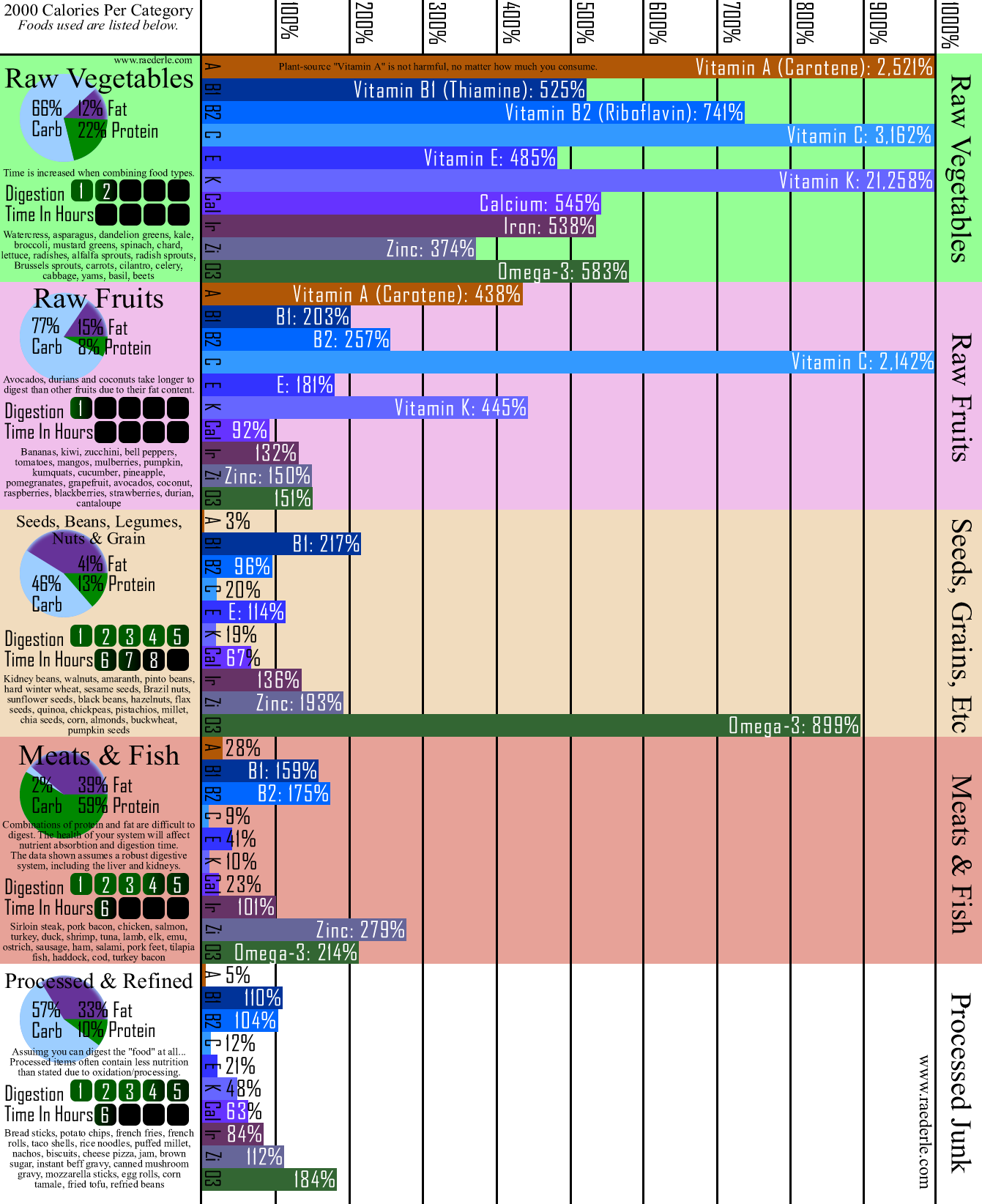
Increase your intake of alkalizing foods. Alkalizing foods are leafy greens, and most fruits and vegetables at large. Acidifying foods are processed foods and most animal products. Dark leafy green vegetables are the king when it comes to get calcium-rich alkaline minerals.
To get a feel for just how nutritious vegetables are, take a look at this chart shown to the right.
|
 |
Hydration
For all aspects of health, it is important to keep hydrated by drinking enough clean water. Water is essential for the utilization of oxygen as well as for the transportation of nutrients and wastes within the body. Without enough water, every bodily function is impaired, including cellular respiration and detoxification.
Breathing Deeply
This one may be obvious: for adequate oxygen you must breathe properly. Deep, slow, steady breaths through the nose into the diaphragm (the belly area) increase the oxygen that is brought into the body. Contrary to what we would be inclined to think, rapid breathing does not increase oxygenation in the body.
Impact Exercises
Daily exercise is vital to oxygen utilization. Our lymph system only moves when we move. We have more than five times as much lymph fluid as we do blood, and yet our lymph fluid has no heart to pump it. Our exercise is the pump for our lymph. For people who spend a ton of time at home behind a desk (like I do), I highly recommend an indoor trampoline for several-minute bursts of lymphatic stimulation throughout the day.
Aerobic exercises such as walking, jumping, swimming, biking, and hiking stimulate all of the organs of the body. While I highly recommend yoga, pilates and Tai Chi, none of these have "impact" to stimulate the lymph system like jumping does. A combination of walking, rebounding (on a trampoline) and yoga (or a similar practice such as Qi Gong) come together to provide a holistic scope of health benefits.
Nature
Keeping plants besides the bed and on the desk is a powerful way to improve the quality of your life. Not only will there be more oxygen in the air (created by the plants), but also, you'll have something green and alive nearby to uplift you. Green has been shown to be the most pleasing color to the human eye. This makes sense, as in the wild it is the color green that indicates a habitat suitable for mankind.
For a particularly powerful boost to your blood-oxygen levels, keep a tray of wheatgrass or sprouts besides your bed and at your desk and eat sprouts and/or drink wheatgrass juice on a daily basis. They'll provide you with oxygen while they're growing directly, and indirectly when you consume them through their alkalizing minerals.
Turn off the heater and put on a sweater!
For incredible relief from dizziness and fatigue reduce use of the heater and air conditioner. Both of these temperature managers remove oxygen from the air, leaving your home and office stale and suffocating. "A breath of fresh air" feels so good because the indoor air has no source of oxygen.
If your home is running a heater/furnace or air conditioner for hours of the day, or all the time, and people are breathing inside, and yet there are no plants replenishing the oxygen indoors, then guess what happens? Your bodily cells begin to starve for oxygen no matter your healthy diet or deep breathing.
Conclusions
Adequate oxygenation has a host of important functions. If you're currently suffering from a lack of oxygen in your body, then increasing the oxygenation of your body will have many benefits, such as increased level of energy and reduced stress.
~ Raederle Phoenix
and Lytenian and Lenny Revell
Quotes From My Sources
"Cancer cells also do not grow well in the presence of oxygen. When oxygen levels are low, cancer cells have more of an opportunity to thrive and multiple. When body tissues have a high alkaline level, they are able to hold much more oxygen as compared to tissues with a high acid level." ~ Alkaline Diet
"An oxygen-depleting diet would consist of one high cooked foods, red meat, sugar, saturated fats, white bread, processed and frozen foods, and carbonated beverages. Switching to an oxygen-rich diet often brings immediate energy and a more vibrant face, skin and positive attitude." ~ Breathing.com
"Oxygen is incorporated by two amino acids, proline and lysine, in collagen chain synthesis. Collagen cannot be synthesized by the fibroblast unless adequate amounts of both proline and lysine are hydroxylated with oxygen. Synthesis requires one atom of oxygen for every three amino acids in sequence. Oxygen is also required in increased amounts during the repair process to provide energy for protein synthesis." ~ Brian A. Youn, M.D.
"Aerobic cellular respiration creates about 30 ATP molecules from each glucose molecule, and anaerobic respiration creates only 2 ATP molecules. Anaerobic respiration releases only a small fraction of the available energy. Cancer cells must feel very tired!" ~ Alkalize For Health
Friday, September 14, 2012
Saving Money On Produce


How can an average person with an average income afford to eat healthier when produce is so expensive?
Listen to this short twenty minute episode to find out: Fresh Produce on A Budget.
Here is how we manage it on a small budget:
We combine all of the following cost-cutting methods. We eat mostly organic so the prices we mention are the prices on organic produce. We believe eating organic is important for our health, and to the planet. Long-term we're saving money by avoiding illness.
Local Produce
- Local Farm Stands (out in the sticks)
- Farmer's Markets
- Pick Your Own
- C.S.A.: Community Supported Agriculture
Bulk Produce
- Order online (raw kelp noodles, raw carob powder, organic toilet paper)
- Order large volumes through a store that gives discounts
Bruised Produce
- Seek discounts on bruised fruit or wilted greens
Grow Your Own Food
- Indoor aerogarden or potted herbs
- Sprouts
- Outdoor garden
- Eat free weeds
- Plant a fruit tree
Some Notes
We went off on a bit of rant about the amazing power of weeds during this episode. Jay and I have been astounded at the power of growing weeds (for a better garden) and eating weeds (for better health). Weeds are free, hardy, and all around beneficial.
We learned about what weeds are safe to eat and the medicinal properties of weeds growing all over the United States in every kind of climate in a powerful DVD set by Markus Rothkranz. It's been a huge bargain to buy the disc set because we save money every day of the summer by harvesting healing food that is growing right in our own back yard.
To get this amazing deal for yourself, visit Markus's website.
Hope this helps you save money on your grocery bill! In the Summer of 2012 we've been able to feed the two of us a healthy nutritionally balanced raw food diet that is 95% organic for under $400 per month, including probiotics. That is only $200 per person, per month, for a 95% organic, 100% raw vegan diet with probiotics included. Our organic C.S.A. membership was indispensable in reaching this incredibly affordable summer.
~ Raederle
Thursday, September 6, 2012
What is Live Food?


Eat Live, Live Well
Our first episode: an introduction, by Raederle and Jay. Click here to open the audio for the show. While you are listening, follow along on the outline below. (Research has shown that reading an outline while listening helps you retain more information. Try it for yourself!)
[The Cause & The Cure]
In the past I – Raederle – have struggled with the following: acid reflux, fatigue, bad breath, flaky scalp, mood swings, itchy eyes, migraines, depression, acne – and more.
You probably have or will experience many of these during your lifetime as well.
Diet can be the cause and the cure.
This show is about providing information to empower you with the ability to heal yourself.

[Live Food]
- Live food is refers to raw food – food that is not processed; food that is not cooked. If you've ever eaten a plain raw apple, carrot, stick of celery or slice of pineapple then you have eaten raw food.
- Raw foods are “alive” because certain aspects of the food “die” when cooked.
- Enzymes are denatured – or “killed” – through heating foods over 105 degrees Fahrenheit.
- Technically some are denatured at 105 degrees and some can withstand up to 118 degrees.
[Enzymes]
- All of the work being done inside any cell is being done by enzymes.
- The cytoplasm of a cell can have a thousand different types of enzymes at any given time.
- Enzymes are chemical-reaction machines.
- Enzymes are made from amino acids. The chain of amino acids folds into a unique shape – a unique enzyme.
- The sugar maltose is made from two glucose molecules bonded together. The enzyme maltase is shaped in such a way that it can break the bond and free the two glucose pieces. The only thing maltase can do is break maltose molecules.
- Lactose intolerance is caused by the inability to digest lactose. Lactase – the enzyme that breaks apart lactose into glucose – is already present in milk before it is pasteurized. Many lactose-intolerant people can drink unpasteurized – raw – milk.
- When food is heated, the enzymes are denatured and no longer work. This creates a demand on our bodies to create enzymes.
- When digesting difficult cooked/processed foods our body will need to convert metabolic enzymes into digestive enzymes.
- A metabolic enzyme is about one-eighth as strong as a digestive enzyme. Thus, we'll lose eight enzymes in our liver, kidneys or heart to make one digestive enzyme in our stomach.
[Protein]
- A protein is any chain of amino acids. An amino acid is a small molecule that acts as the building block of any protein.
- As far as your body is concerned there are two different types of amino acids: essential and non-essential.
- Non-essential amino acids are amino acids that your body can create out of other chemicals found in your body.
- Essential amino acids cannot be created, and must be obtained through food.
I grew up on a diet that was almost wholly cooked/processed. I had milk on plain unsweetened wheat-based cereals for breakfast or eggs on buttered toast. For lunch I ate yogurt, ramen noodles, more cereal or leftovers from the previous night's dinner. For dinner my family aimed to serve one portion of meat, one or two cooked vegetable options and potato or pasta.
It was just as the old food pyramid suggested – lots of breads, pastas and starch, a little vegetable, a little meat, a little dairy and the occasional fruit.
As a toddler I was always tired. As a pre-teen I had constant infections. As a teenager I began to get daily acid reflux, migraines and anxiety attacks. Doctors blamed this on genetics and prescribed pills for me that made me nauseated or gave me headaches.
As a toddler I was always tired. As a pre-teen I had constant infections. As a teenager I began to get daily acid reflux, migraines and anxiety attacks. Doctors blamed this on genetics and prescribed pills for me that made me nauseated or gave me headaches.
My husband – Jay – has experienced food-related problems as well.
[Complete Protein]
- Misconception: One must eat certain kinds of food, such as meat, in order to get a "complete protein."
- The myth that vegetables have incomplete proteins was popularized by a book in the 1970s called "Diet For A Small Planet" by Frances Moore Lappé. The same author released another book with the same title in the 1980's where she admitted she was wrong. In other words, the person who came up with the idea of a "complete protein" recanted ten years later.
- A "complete" protein is defined by having all of the essential amino acids.
- All vegetables, even a cucumber, have all essential amino acids that make up a so-called "complete" protein.
- As long as you're eating enough calories, you're eating enough protein.
- The World Health Organization recommends that 5% to 10% of the calories we consume should come from protein.
- The calories in a vegetable average 22% from protein, 10% from fat and 68% from carbohydrate.
- When you consider herbivores in the wild, such as gorillas and elephants, raw fresh vegetables is the base of their diet, and is enough for them to grow stronger, larger and healthier than humans.
[Celery]
- Celery calorie breakdown: 9.2% from fat, 17.2% from protein and 73.6% from carbs.
- Celery is typical for a vegetable.
- Celery takes more calories to chew it than it provides. It's a great weight loss food.
- Chewing celery itself combats stress by releasing comforting hormones in the brain.
- Celery is also great for hydration. It has high water content and some structured sodium.
- Celery alone is plenty of protein from a quantitative standpoint.
[Watercress]
- Watercress calorie breakdown: 7.9% from fat, 42.1% from carbs and a whopping 50% from protein.
- Compare to beef: 41.7% calories from protein.
- Compare to kidney beans: 23.7% calories from protein.
- By calorie, watercress has more protein than beef, and more than twice as much protein than most beans.
- We only need 5% to 10% of our calories to come from protein. (Depending on how active we are and how many total calories we eat.)
[Protein & Digestion]
- The protein in beans, meat and nuts is digested differently than the protein in vegetables.
- The protein in watercress is easily digested. There is fiber, water and minerals that work with the protein in your body.
- In raw plant foods, such as watercress, all the enzymes are active and ready to be catalysts for chemical reactions.
- When you're not stealing metabolic enzymes from your organs to help you digest your food, you have a lot more energy.
- The dense fat and denatured protein in many cooked foods is so arduous to digest that you spend hours trying to digest it.
[Hormonal Balance]
- Quick digestion is vital to hormonal balance.
- A hormonal imbalance leads to depression, insomnia, fatigue, anxiety, inability to gain muscle and difficulty losing weight.
- Hormonal functions are affected by every aspect of our lives: stress levels, when we sleep, how long we sleep, etc.
- Insulin levels go up when we eat, and insulin is a hormone.
[Insulin & Growth Hormone]
- We've been told that small meals throughout the day is good – that it will keep our blood sugar steady.
- If a hormonal imbalance is already present, this may create more trouble.
- When insulin is up our growth hormone is down.
- Growth hormone is what allows us to build muscle and burn fat.
- If you're still digesting when you begin to exercise and/or start eating immediately afterward then you don't produce much or any growth hormone. Therefor you don't build muscle or burn fat effectively.
- This topic is something that Dr. Ritamarie discusses in detail in her literature.
[Sensitive Digestion]
- If you have a sensitive digestion then exercising while you're still trying to digest food can upset the entire body.
- Exercising during digestion may cause stitches in your sides, sudden fatigue, dizziness, nausea or acid reflux.
- Drawn-out digestion can block muscle production, hinder weight loss, cause fatigue and lessen nutrition extraction.
- When we fail to digest something within our stomach, further digestion in our intestines is not probable.
- Instead of consuming the food ourselves, bacteria and parasites eat it instead.
[Bacteria/Parasites/Flora & Intestinal Health]
- When you take antibiotics or come in contact with strong molds or bacteria then our helpful flora is killed off in droves.
- Healthy flora is often replaced with the bad bacteria, or an overgrowth of bacterias that were good in small amounts. (This often happens with yeast, which becomes a candida problem.)
- A hundred years ago we could have had the healthy bacteria put back into our bodies by drinking from a river or well or consuming some dirt on a plant.
- If your mother didn't have healthy flora then neither did you when you were born. This is why more and more children today have such a weak immune system. (I was one of those babies.)
[Flora & B-Vitamins]
- Healthy flora is important for absorption of b-vitamins which regulate our nervous system.
- Without adequate b-vitamins we may not be able to smell well, think clearly or feel happiness.
- The brain is a mass of nerves, and without b-vitamins it doesn't function correctly.
- Lack of b-vitamins can result in schizophrenia.
- I've personally encountered many people who cured their schizophrenia by taking b-vitamin supplements.
- However, if you have healthy flora and a healthy diet, getting enough b-vitamins is easy without supplements.
[Quickly Digesting Foods]
- Raw fruit and vegetables digest quickly.
- Melons only take about twenty minutes to digest, as they are primarily water.
- Most raw fruits take thirty to fifty minutes to digest.
- Fatty fruits are an exception. Coconuts, olives and avocados take several hours.
- Most raw vegetables take an hour or two to digest. Vegetables take longer is because of vegetable fiber which must be pulled apart from the minerals and sugars present in the vegetable.
- Beans, meat, dairy, eggs, fish and most cooked foods take a bare minimum of three hours to digest.
- These amounts are based on a healthy digestive system. Many people still have food inside their intestines from three days ago.
[Fiber]
- The fiber is great – its like an army of little brooms coming to clean your intestines.
- People with serious conditions may want a faster approach.
- The fastest and most effective digestion possible will occur when drinking fresh home-made raw juice.
- Juice is the essence of plants minus the fiber.
- The difference between a juicer and a blender is that the juicer removes the fiber from the food and puts it into a pulp bin separate from the juice.
- An inexpensive centrifuge juicer can cost as little as $70.
- We own the L-equip XL, a centrifuge juicer that cost about $100 dollars.
- A centrifuge juicer is great for making juice from carrots, apples, celery, citrus, tomatoes, chard stems and beets.
- We also own the Omega 8005, a masticating juicer, which uses a mashing-squishing action instead of spinning blades.
- The Omega 8005 cost us about $250 dollars.
- A masticating juicer is excellent for juicing spinach, lettuce, wheatgrass – any leafy green – and it also can do carrots and celery well but it is much slower with these foods than our centrifuge.
[Juice Recipes]
Centrifuge Juicer:
- 5 carrots
- 5 celery sticks
- 2 tomatoes
- 1-2 lemons
You may also add half a beet or a whole beet, chard stems or apples.
This juice is loaded with nutrition, providing plenty of beta-carotene which we turn into vitamin A within our bodies, a full day's supply of vitamin C and in 250 calories this juice provides 8 grams of protein.
This juice is loaded with nutrition, providing plenty of beta-carotene which we turn into vitamin A within our bodies, a full day's supply of vitamin C and in 250 calories this juice provides 8 grams of protein.
Masticating Juicer:
- 1 head of romaine lettuce
- 1 bunch of parsley or cilantro
- 1-2 lemons
In just 150 calories this juice provides the full day's supply of vitamin A, vitamin C, vitamin K, folate, half our needs for the array of b-vitamins excluding B12, as well as about a third of our needs for minerals. In those 150 calories is 11 grams of protein.
It would take over 200 calories of sausage to get 11 grams of protein. But you'd also get 18 grams of toxin-laden fat and virtually no nutrition except some zinc. We'll talk about why I call it "toxin-laden fat" in a later episode.
You can check out more juice recipes here.
[Final Words]
- It's our aim to empower you to be happy and healthy.
- If you're feeling inspired or empowered right now, then we'll consider this a job well done.
- If you're feeling staggered or overwhelmed, then take a break, drink some water and do something fun.
Thanks for listening to Eat Live; Live Well with Raederle and Jay.
If you have a heath or fitness question you'd like us to answer visit the contact page.
~ Raederle & Jay
Tuesday, August 28, 2012
Surviving Cancer | An Interview With Paul | 90 Pounds Lost!

On this show, Raederle and Lytenian interview a raw vegan named Paul Klein.
To listen to the audio for this show, click here.
Paul says: "I started losing a pound a day. My friends thought I was goner. I knew that I was okay. I felt great. I felt better than I ever had in my life." He goes on to say in regards to his allergies and diverticulitis: "I haven't been bothered with that stuff in the past thirteen years." The doctors said it would never go away. "But it did go away when I changed my diet."
The following is a written description written by Paul of his story and edited by Raederle (previous to the show recording).
Following that is an excerpt from the book that had such an impact on Paul, Nature's First Law.

Paul's Story
My motivation for changing to a raw organic diet was to avoid surgery, poisonous drugs, radiation, chemotherapy, extreme sickness and the possibility of a painful death.
Years earlier, I went through an experience with a business partner who died within four months after being diagnosed with melanoma cancer. His attempt to regain his health via the conventional medical method was futile. He and his family suffered greatly.
My business partner's life ended in four months of horrific pain and suffering. He left behind a young wife, son and daughter. My own cancer symptoms were identical to his and I did not want to go that route. Because of many other prior health issues, I had been learning and studying alternative healing modalities.
I had heard of macrobiotics. I knew of Dr. Satarino who chose to go the route of building up his immune system with healthy whole foods. Dr. Satarino was in his thirties at the time. He knew that the standard medical treatment would not be successful. He chose to change his diet. He literally "ate his cancer away."
When my cancer was discovered, I immediately changed my diet to a completely organic diet of raw vegetables, fruits, seeds and nuts. The bulk of my diet became green leafy veggies. This diet was outlined in a book called "Living Foods for Optimum Health" written by Dr. Brian Clements, Phd., the director of the world renown Hippocrates Health Institute in Boca Rottan, FL.
I had also researched "Nature's First Law" by Arlin, Dini & David Wolfe, along with the books written by the originators of Hippocrates Health Institute, Dr. Ann Wigmore and Viktoras Kulvinskas.
Overnight, my black, itchy, fast-growing-cancerous mole gave me the push to start detoxifying. I made the commitment to filling up all of my trillions of cells with powerful Life Force.
I changed my diet radically from acidic to alkaline. My cancerous mole disappeared within four months. My arthritic pain – of thirty-three years – went away. My diverticulitis – of eighteen years – went away. My lifelong allergies vanished as well.
Forty years previously I had been in a serious car accident that had plagued with me severe back pain and a bad knee. That pain also vanished in the same four months.
My energy levels shot sky high. My clarity and happiness skyrocketed.
The eye doctor who examined my eyes said that I was born with astigmatism and that can never be corrected. After two years on this organic raw food diet I got rid of my reading bifocals and driving glasses.
In over eleven years I've been eating organically grown raw foods, I haven't had one cold or flu. I never get indigestion or acid reflux.
When I went fully raw, organic and vegan my spirituality took a huge upward spike. It was the most amazing experience of my entire life.
An organic, raw and vegan diet, in my opinion, is the most sensible and economical way to eliminate and prevent disease and pain.
Through years of seminars, lectures, documentaries, books, workshops, interviews with raw fooders, I have attained the knowledge to heal myself. It's a shame that this information is not embraced at universities.
This information may be repressed because of the negative economical impact it would have on the established pharmaceutical and medical corporations.
Only a few industries have made money from my healing: Organic farmers, organic grocery stores, and those teaching natural healing through food, exercise, clean air and water.
The money I've invested in my raw food education has been far less than what most people throw away in prescription drugs, surgeries, doctor visits, and expensive hospital stays.
Hippocrates said, over two thousands yeas ago, "Make food your medicine, and medicine your food". He was right, and anyone can prove this. Try this diet for one month and keep a journal of your feelings and health improvements.
If you can afford it, take every test available in the medical community. Get your levels of each vitamin measured, as well as cholesterol levels, etc. Then, after a year of on a natural lifestyle, go back and have all the exact medical tests taken again.
It will blow those medical examiners away and open their eyes. Responsible doctors are admitting that prevention is far superior to treating the symptoms.
I have never been happier and more in love with life, my self, my wife, our family, friends and all our acquaintances as I am now.
If you need any help or encouragement, just give me a call, I am happy to share this "Life/Love Altering Experience" with anyone wanting to take responsibility for their own health and happiness.
Namaste, Happy Trails, Much Love
– Paul Klein
#716 884 0099
To see what a nori wrap looks like (what Paul called "sushi") and to get a couple recipe ideas, check out this nori wrap recipe.
To find local groups in your area that have raw vegan potlucks, visit meetup.com and type in "raw food" in the search engine on the site. Also try "living cuisine" and "vegan" because these groups will have overlap in the sorts of events that they have.
Below are some statistics that Paul shared with Lytenian, Raederle and other folks at a potluck from a book. We considered having Paul read these during the show, but ran out of time. But, for your benefit, here they are anyway:
The following stastics were primarily compiled by John Robbins and Howard
Lyman. They were revised and updated in the book Nature’s First
Law. Most of these facts compare a vegetarian diet to an omnivore
diet. Remember that the differences are much greater when compared to
a raw food diet.
Humans and Livestock
Human population of the United States: 300 million
Number of humans that can be fed by the grain and soy beans eaten by U.S. livestock: 1.4 billion
Percentage of corn grown in U.S. eaten by livestock: 85% Percentage of corn eaten by humans: 15% (99% is cooked)
Percentage of oats grown in U.S. eaten by livestock: 95% How frequently a child dies of starvation: every 2 seconds
Potatoes that can be grown on 1 acre: 20,000 pounds Beef that can be grown on 1 acre: 165 pounds
Percentage of U.S. agricultural land used for the production of animal foods: 85%
Percentage of U.S. agricultural land used to produce beef: 56%
Amount of grain and soybeans needed to produce 1 pound of feedlot beef: 16 pounds
Number of children who starve to death each day: 40,000
The amont of land needed to feed one omnivorce can feed 20 vegetarians.
That same land can feed around 150 raw vegans.
Trees
Amount of U.S. forest which has been cleared to create cropland to produce a meat-centered diet: 260 million acres
How often an acre of U.S. trees disappears: every 8 seconds
Trees spared yearly by each individual who switches to a vegetarian diet: 1 acre
Rainforests
Rate at which precious rainforest land is being lost: 2.4 acres per second
A driving force behind the destruction of the tropical rainforests: American meat habit
Current rate of species extinction due to destruction of tropical rainforests and related habitats: 1,000 per year
Water
Cost of common hamburger meat if water used by meat industry was not subsidized by U.S. taxpayer: $35 per lb
Current cost for 1 pound of protein from wheat: $1.50
Current cost for 1 pound of protein from beef steak: $15.40
Cost for 1 pound of protein from beefsteak if U.S. taxpayers ceased subsidizing meat industry’s water use: $89 per pound
Medical School & Nutritional Studies
Number of U.S. medical schools: 125 Number of U.S. medical schools with a required course in nutrition: 30
Training in nutrition received during four years of medical school by the average U.S. physician: 2.5 hours
Percentage of the U.S. National Cancer Institute’s budget devoted to nutritional studies: less than 1%
Heart Attacks
A heart attack strikes in the U.S.: every 25 seconds
A heart attack kills in the U.S.: every 45 seconds
Most common cause of death in the U.S.: heart attack
Risk of death from heart attack by average U.S. woman: 46%, man: 52%
Risk of death from heart attack by average American purely vegetarian woman: 3%, man: 4%
Source: Nature's First Law
~ Raederle Phoenix
~ Lytenian
~ Paul Klein
If you have a heath or fitness question you'd like us to answer on the show, e-mail us. Visit the contact page.
Visit the Site Map to find more radio show episodes or articles of interest.
Subscribe to:
Posts (Atom)
Popular Posts This Month
-
How Does A Haas Avocado Compare To A Slimcado? We all love Haas avocados. Guacamole is incredibly awesome. So aweso...
-
 Language shapes our thoughts. What we can put into words, we can conceive and understand – at least intellectually. Without words, we...
 -
Language shapes our thoughts. What we can put into words, we can conceive and understand – at least intellectually. Without words, we’re ...
-
 Introduction The GAPS diet has three primary parts: Eliminating starches (complex carbohydrates) Adding in meat stock made from w...
 -
 Vegans are sometimes responsible for more animal exploitation than omnivores. This is a conclusion I've come to after a l...
 -
Ten Different Ways To Get All The Vitamin C You Need In One Day From Whole Foods The Myth Ascorbic ...
-
 Do you prefer to learn from videos or from text? If you prefer video, click here for the video version of this masterclass. Refer bac...
 -
& Are we overpopulated? It is widely believed world is overpopulated. In this essay I will prove that to be false. This arti...
-
What's wrong with beans? Beans are really hard to digest. Unlike many foods which contain mostly one of t...
-
 When healthy foods become a problem . . . Desulfovibrio De sulf ovibrio is a genus of gram-negative, anaerobic, “sulfate-reducing” bacteria ...


Featured Post
Your Identity = Your Boundaries
Your identity is the sum of your boundaries: the things to which you say “Yes,” and the things which you say “No.” What is your favorite f...
